


The lifespan of a flexible hose does not depend solely on working hours, but on its continuous interaction with high pressures, pulsations, overheating, micro-movements, and environmental contaminants. Every hose is a critical component: it represents the exposed point of the system, and its integrity affects safety, efficiency, and production continuity. A degraded hose does not warn you: it fails. And when it fails, it causes downtime, oil loss, environmental risk and, in the worst cases, harm to people.
Replacement should never be approached as a reactive activity, but as an engineering decision based on objective indicators, expected life cycles, operating conditions, and predictive signals. Identifying the correct moment makes it possible to anticipate failure and protect the entire hydraulic system.
Signals to monitor: visible and invisible deterioration
A flexible hose communicates its health through both external and internal symptoms. Some are immediately recognizable, while others require structured inspections and measurement tools. High-level maintenance starts with identifying these indicators.
1. Abrasion and external damage
The outer cover is the first barrier against impacts, rubbing, and chemical agents. Deep abrasions, cracks, or cuts expose the reinforcement layers, drastically reducing resistance to nominal pressure. This phenomenon is typical of hoses installed with overly tight bends or near moving components that are not adequately protected.
2. Micro-leaks and “sweating”
Oil seeping through the outer cover is a sign of internal hose degradation. It is not a simple surface leak: it indicates that the inner rubber has lost elasticity or has micro-cracks. Pulsating pressure accelerates failure.
3. Abnormal stiffness or loss of flexibility
The hose must maintain its elasticity. A stiffened hose indicates material aging, exposure to excessive temperatures, or chemical incompatibility between the inner rubber and the hydraulic fluid. Hardening can precede sudden ruptures, especially in the most stressed areas.
4. Pressure surges or abnormal vibrations
Under pressure, a weakened hose may “bulge” in certain points, temporarily altering internal volume. These phenomena generate pressure fluctuations, line vibrations, and actuator instability. This is a high-risk pre-failure signal.
5. Hose age and working hours
Each manufacturer indicates the expected life cycle of the hose based on temperature, pressure, and application dynamics. Respecting the replacement schedule is essential. An aged hose may appear intact but have a compromised structure.
Why replace them: safety, efficiency, and operational economy
Timely hose replacement is not a “maintenance cost,” but a measure to protect the value of the system. The effects of even a minor failure are significant.
1. Preventing downtime
When a hose fails, the machine stops immediately. If the line is part of a continuous production cycle, economic losses are proportional to the length of the downtime and the complexity of the intervention.
2. Protecting pumps and sensitive components
A damaged hose can degrade the fluid, introduce air into the circuit, or generate abnormal pressure spikes. Any unexpected variation reduces the volumetric efficiency of the pump and accelerates wear of valves and actuators.
3. Operator safety
High-pressure oil sprays are one of the main causes of accidents in hydraulic systems. High temperatures, pressures exceeding 250 bar, and unpredictable trajectories represent a serious risk.
4. Reducing environmental leaks
A rupture inevitably results in fluid dispersion. Beyond the cost of the oil, there is significant environmental and regulatory impact, especially in controlled industrial environments.
Materials, pressures, bends, compatibility: correct selection is an engineering choice
Replacement must not be limited to “putting on a new hose.” A flexible hose is a technical component and must be sized precisely. Nominal pressure, peak pressure, minimum bend radius, temperature, working dynamics, oil compatibility, and environmental conditions are variables that must be rigorously evaluated.
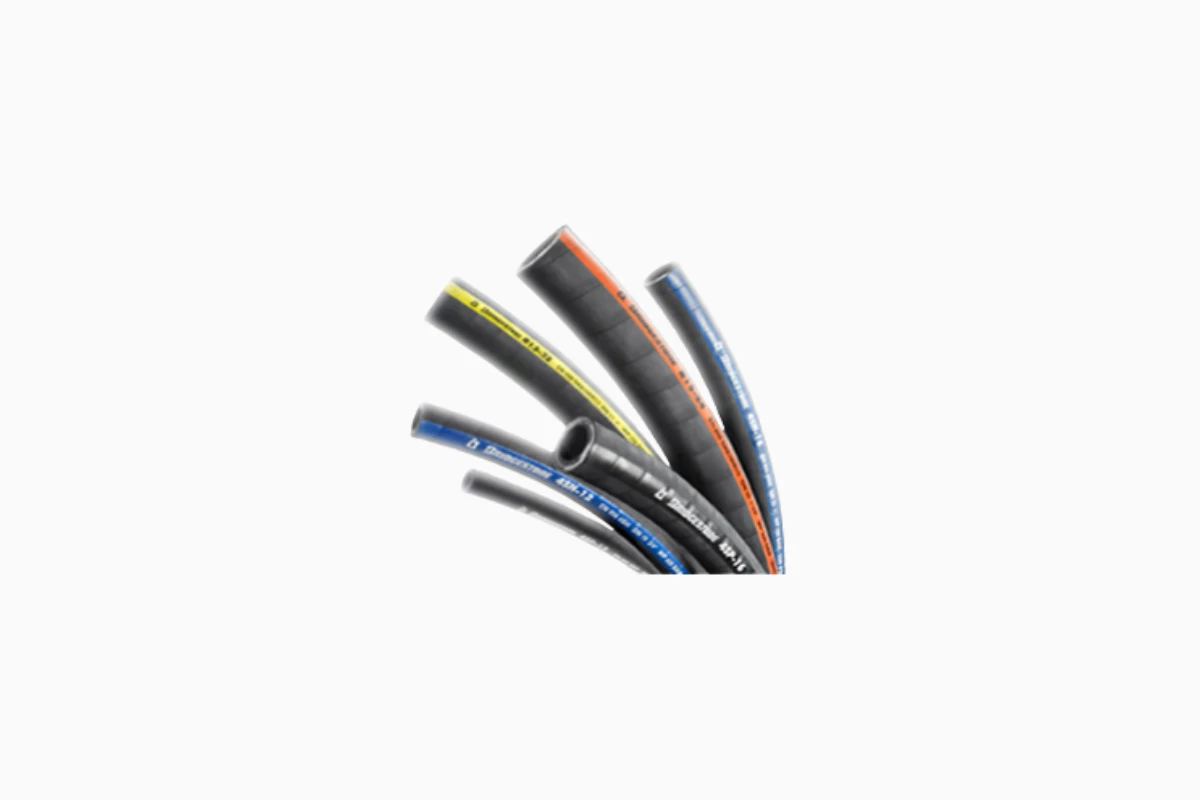
In addition, brand and build quality play a crucial role. Intertraco – Bridgestone flexible hoses represent a high standard in terms of resistance, durability, and certifications.
How to define scheduled replacement: from reactive to predictive maintenance
Modern hose management integrates visual diagnostics, analysis of working parameters, and data logging.
1. Installation and wear log
Each hose should have a dedicated record with installation date, code, working pressures, and environmental conditions. This allows replacement to be planned before failure occurs.
2. Stress indicators: temperature, pressure, and cycles
High temperatures accelerate material decay. Pulsating pressures reduce service life. Logging operational data provides a realistic estimate of remaining life.
3. Analysis of recurring failure causes
If a hose fails repeatedly in the same area, the problem is not the hose: it is the layout. Minimum bend radius not respected, excessive vibrations, incorrect clamp tightening, or mechanical interference must be corrected structurally.
Errors to avoid during replacement
1. Undersizing burst pressure
The maximum pressure should never be “at the limit.” The safety factor must be adequate for pulsations and duty cycles.
2. Reusing damaged fittings
Worn fittings compromise the seal of even the best hose. Every replacement should include an inspection (and preferably replacement) of the fittings.
3. Using hoses incompatible with special oils
Synthetic fluids, biodegradable oils, or high-viscosity-index formulations require specific rubbers. Incompatibility accelerates internal hose degradation.
4. Installing hoses that are too “tight” or too “loose”
The hose must compensate for movements without causing stretching or unnecessary loops.
When should flexible hoses be replaced? The definitive technical rule
Replacement must occur when:
- physical signs of degradation appear;
- the system’s performance varies without apparent cause;
- the hose has reached the manufacturer’s stated life cycle;
- even a single micro-leak is detected;
- the hose operates outside its specifications (temperature, bending, pressure);
- structural modifications to the system are underway.
A single signal is enough to schedule replacement.