


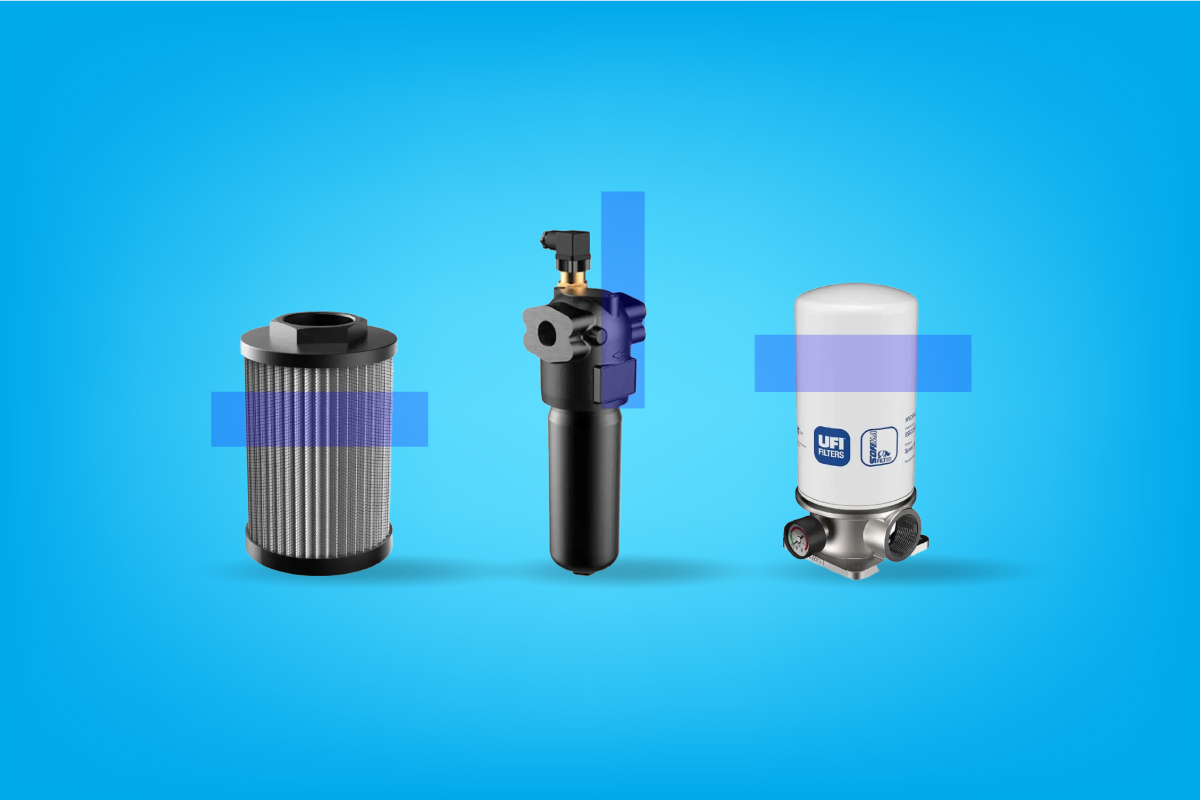
In a hydraulic system, oil transmits power, lubricates, cools, and protects. When the fluid becomes contaminated, the entire system loses efficiency, precision, and reliability. Filtration is not an accessory—it is a structural function of the circuit. The position of the filter determines which contaminants it captures, when it captures them, and how effectively it protects critical components.
Understanding the role of suction, pressure, and return filters means designing longer-lasting systems, reducing downtime, and lowering the total cost of ownership.
Contamination: the real enemy of hydraulic systems
Every hydraulic system must deal with three forms of contamination: solid, liquid, and gaseous. Solid particles originate from machining processes, internal wear, and environmental dust. Liquid contaminants include water and incompatible fluids. Air enters the circuit in the form of microbubbles.
These impurities act like invisible sandpaper. They accelerate wear on pumps, valves, and actuators, increase internal leakage, and compromise fluid stability. The result is a system that consumes more energy, runs hotter, and delivers less performance.
Filtration does not eliminate the problem once and for all. It manages it continuously, keeping contamination levels within limits compatible with component tolerances.
Why filter placement is strategic
A filter never works in isolation. It works at the point in the circuit where it is installed. Suction, pressure, and return are not alternatives—they are complementary functions. Each position intercepts different contaminants and protects different components.
Ignoring this logic leads to two common mistakes: filtering where it is not needed and under-protecting where the risk is highest.
Suction filters: primary protection for the pump
Technical function of the suction filter
The suction filter operates between the reservoir and the pump. Its role is simple and vital: preventing coarse contaminants from entering the pump. Sand, machining debris, and metallic residues must never reach the suction elements.
Concrete benefits of suction filtration
A properly sized suction filter:
- reduces the risk of pump seizure
- limits premature wear of rotating components
- protects the most expensive investment in the circuit
Suction filtration does not need to be fine. It must be reliable and offer low pressure drop. It works like a sturdy sieve: it lets oil flow freely while stopping anything that should never enter.
Risks of an incorrect choice
An overly fine suction filter causes cavitation. The pump struggles to draw oil, bubbles form and implode, and metal surfaces erode. The damage is rapid and irreversible.
This is why choosing the right component is crucial. UFI suction filters are designed to provide protection without restricting flow.
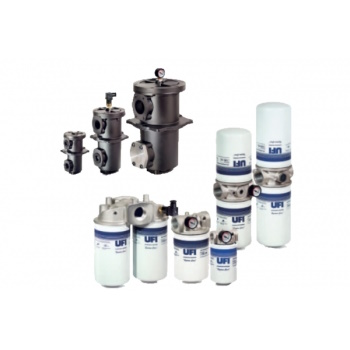
Pressure filters: protecting precision components
Why pressure filtration is the most critical
The pressure filter is installed downstream of the pump, where pressure is highest and the fluid feeds valves, manifolds, and actuators. Here, contamination becomes lethal.
Proportional valves and servo valves operate with micrometric clearances. A single particle can jam a spool, alter a setting, or cause intermittent malfunctions that are difficult to diagnose.
What a pressure filter really protects
Pressure filtration:
- stabilizes system performance
- preserves motion accuracy
- reduces production scrap
- extends the life of valves and cylinders
At this point in the circuit, filtration must be fine, consistent, and monitorable. It is the true heart of hydraulic quality.
Direct effects on productivity
A system with effective pressure filtration maintains repeatable responses over time. Machine performance does not “age.” Technicians are not forced into constant recalibration. Production managers see fewer unplanned stoppages.
UFI pressure filters are designed for exactly this scenario: high separation efficiency, resistance to high pressures, and compatibility with clogging indicators.
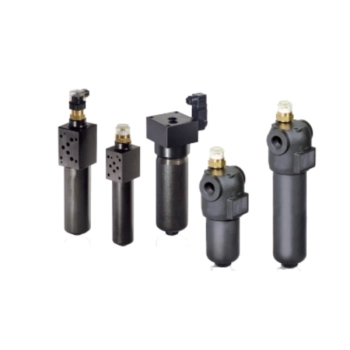
Return filters: controlling system contamination
The often underestimated role of return filters
The return filter operates before the oil flows back into the reservoir. Here it captures everything generated by the system: wear particles, residues, and contaminants introduced during operation.
It is the ideal point to keep the reservoir clean and prevent continuous re-contamination of the fluid.
Why the return line is strategic
Filtering on the return line means:
- reducing overall contamination load
- extending oil service life
- improving the effectiveness of other filters
This creates a virtuous cycle. Less contamination in the reservoir means less stress on suction and reduced workload for pressure filtration.
Typical applications
Return filtration is particularly effective in continuous industrial systems, presses, machine tools, and applications with high wear particle generation.
UFI return filters handle large flow rates with low pressure drop, keeping the fluid under control without interfering with system dynamics.
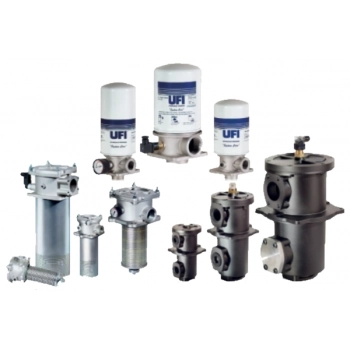
How to correctly combine suction, pressure, and return filtration
A reliable system does not choose just one filtration point. It coordinates all of them.
- Suction: pump protection
- Pressure: protection of precision components
- Return: continuous system cleanliness
This architecture reduces the load on each individual filter and stabilizes contamination levels. It is the approach used in industrial systems designed to last for years, not months.
Filtration and predictive maintenance
Modern filtration does more than trap particles—it provides information. Clogging indicators, differential pressure sensors, and oil analysis turn the filter into a diagnostic tool.
An abnormal increase in clogging signals accelerated wear. A sudden change in oil color anticipates a problem. Filtration thus becomes an integral part of predictive maintenance.
Reducing total costs through filtration
Many hydraulic costs do not appear in accounting as “filters.” They show up as:
- machine downtime
- premature spare parts
- production scrap
- higher energy consumption
A correct filtration strategy reduces these costs at their source. It is a technical choice that generates measurable economic value.
Suction, pressure, and return filtration are not redundant. They form an integrated protection system. Each position serves a specific function. Ignoring this means accepting inefficiency, wear, and instability as unavoidable.
Those who design or maintain reliable hydraulic systems know that fluid quality determines machine quality. And fluid quality depends, first and foremost, on where and how it is filtered.