


In the plastic injection molding and die casting sector, mold temperature control is not a minor technical detail: it is a determining factor for part quality, cycle times, and tooling lifespan. The components of mold temperature control circuits directly influence production process stability and result repeatability.
A mold operating at non-uniform temperature generates internal stresses in the material, dimensional deformation, and non-compliant surface finishes. A properly designed circuit, on the other hand, maintains thermal balance, reduces cooling times, and ensures faster and more predictable cycles.
The Principle of Mold Temperature Control: Thermal Balance and Continuity
The temperature control circuit regulates mold temperature through the circulation of a heat transfer fluid, typically water or oil. Its task appears simple: to transfer heat in a controlled and uniform manner.
Imagine the mold as a thermal battery. During injection, it accumulates heat; during the cooling phase, it must dissipate it quickly but without fluctuations. If the fluid flow is not uniform or if dead zones exist in the circuit, some areas cool faster than others. The result is an uneven distribution of stresses in the molded material.
A well-designed system ensures that every point of the mold receives the correct flow rate, at the set temperature and with stable pressure.
Key Components of Mold Temperature Control Circuits
Quick Couplings: Safety and Operational Continuity
Quick couplings are among the most critical elements of the circuit. They allow rapid connection and disconnection of the mold without fluid leakage and without compromising operator safety.
A high-quality coupling must ensure:
- perfect sealing even at high temperatures
- resistance to repeated opening and closing cycles
- reduced pressure losses
Even minimal leakage, repeated hundreds of times, results in pressure drops and thermal instability. In addition, seepage can create scale deposits that over time compromise heat exchange efficiency.
Distribution Manifolds: Flow Uniformity
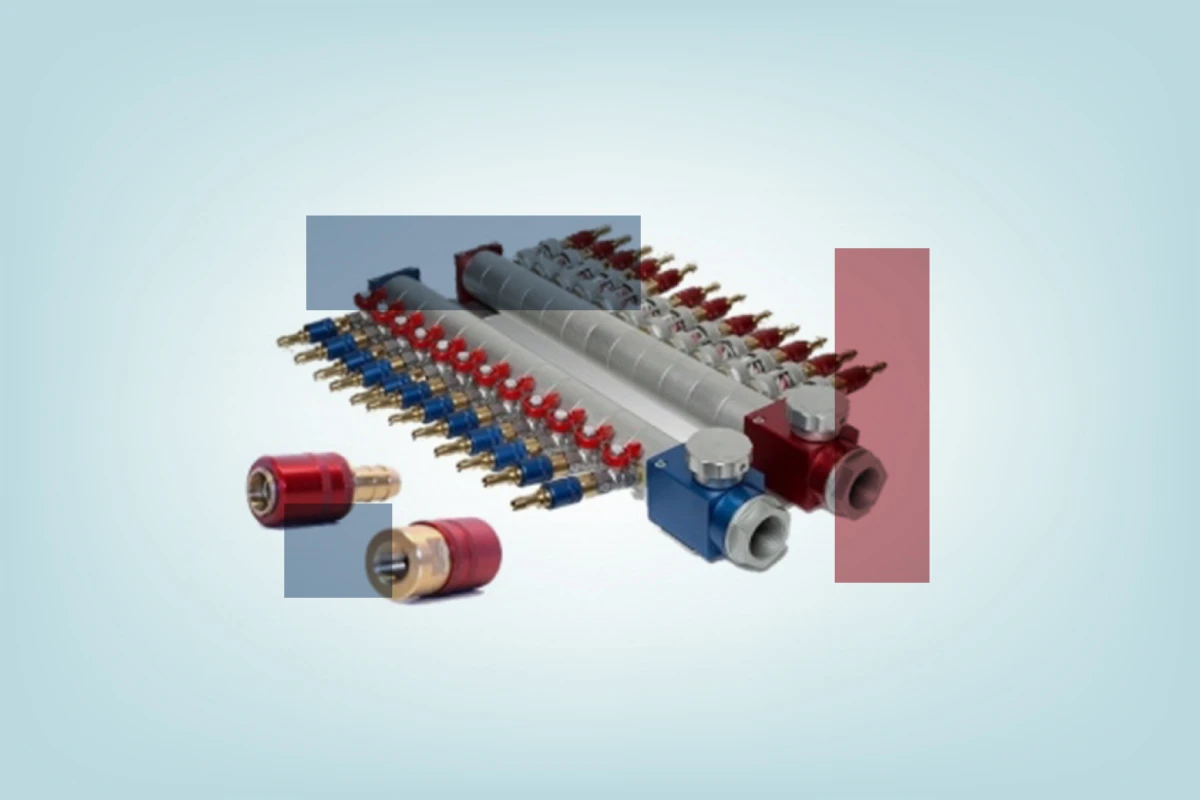
The manifold acts as the central node of the circuit. It distributes fluid to the different mold channels and collects the return flow. Its design directly affects line balancing.
If a manifold has non-optimized internal sections or geometries that promote excessive turbulence, the flow will not be distributed evenly. Some circuits receive more flow, others less. The result is uneven cooling.
Solutions such as quick couplings and manifolds for mold temperature control make it possible to create modular and customized configurations, optimizing fluid management and simplifying maintenance operations.
Pipes and Fittings: Continuity Without Restrictions
Pipes represent the infrastructure of the circuit. Even a simple reduction in cross-section or an overly tight bend can increase pressure losses and alter flow distribution.
The heat transfer fluid must flow like on a highway without obstacles. Every restriction is equivalent to a lane narrowing that slows traffic. In molding, this slowdown translates into unexpected temperature variations.
Choosing materials resistant to operating temperature and pressure completes the system’s reliability framework.
Common Causes of Inefficiency in Temperature Control Circuits
Many production issues originate from suboptimal thermal management. The most frequent causes include obstructions due to limescale deposits, fluid contamination, improper line balancing, and undersized components.
Scale buildup progressively reduces the internal cross-section of the channels, decreasing effective flow rate. It is a gradual process that often goes unnoticed until defects appear in the molded part.
Incorrect fluid selection can also have a negative impact. A fluid not suited to operating temperatures alters its physical properties, compromising heat exchange.
The Role of Flow Rate and Pressure in Thermal Control
Flow rate and pressure are not independent parameters. Excessive pressure can generate stress on components and increase the risk of leaks. Insufficient flow rate, on the other hand, reduces heat removal capacity.
Optimal management requires a balance between these two factors. Increasing flow indiscriminately is useless if distribution is not uniform. It is like increasing plant speed without monitoring quality: it only amplifies existing criticalities.
Proper component sizing ensures operational stability and cycle repeatability.
The Role of Heat Exchangers in Mold Temperature Control
The heat exchanger represents the main temperature regulation point of the fluid. If the system cannot dissipate the heat accumulated during production cycles, the inlet temperature to the mold progressively increases.
This phenomenon generates a domino effect: longer cycle times, altered surface quality, and greater stress on the plastic material.
A properly sized heat exchanger keeps the fluid within a constant range, ensuring long-term stability even during extended production runs.
Predictive Maintenance for Temperature Control
Relying exclusively on corrective maintenance means intervening when the problem is already evident. A predictive approach instead allows constant monitoring of parameters such as temperature, flow rate, and pressure.
Periodic circuit analysis makes it possible to identify abnormal variations before they turn into production defects. Even simply comparing supply and return temperatures provides valuable insight into system efficiency.
Early intervention means avoiding scrap, rework, and unplanned downtime.
Integration with Automation Systems and Industry 4.0
Modern temperature control circuits can integrate with digital monitoring systems. Temperature sensors and flow meters transmit real-time data, enabling dynamic adjustment.
In this context, the circuit is no longer a passive system but an active component of process control. Thermal stability becomes a measurable and optimizable parameter.
This evolution enables the transition from empirical management to data-driven management.
Why Invest in High-Quality Components
In the molding sector, finished part quality also depends on seemingly secondary elements such as couplings and manifolds. An inadequate component can generate micro-leaks, flow variations, and thermal instability that directly affect the product.
Investing in reliable components means reducing uncontrolled process variables. It means protecting the mold, reducing wear, and ensuring faster and more consistent production cycles.
A temperature control circuit designed according to proper engineering criteria improves company competitiveness. It reduces scrap, increases productivity, and ensures long-term repeatability.
The Circuit as a Strategic Lever
The components of mold temperature control circuits are not simple accessories. They form the architecture that governs the thermal balance of the entire production process.
When flow rate, pressure, and distribution are properly balanced, the mold operates under optimal conditions. Cycle time decreases, quality improves, and tooling lifespan increases.
In the competitive molding market, thermal control is not a technical detail. It is a strategic advantage.