Download
Catalogs and technical documentation
 FOX HGV Series Inline Hybrid Bladder – Bellows Pulsation Dampener


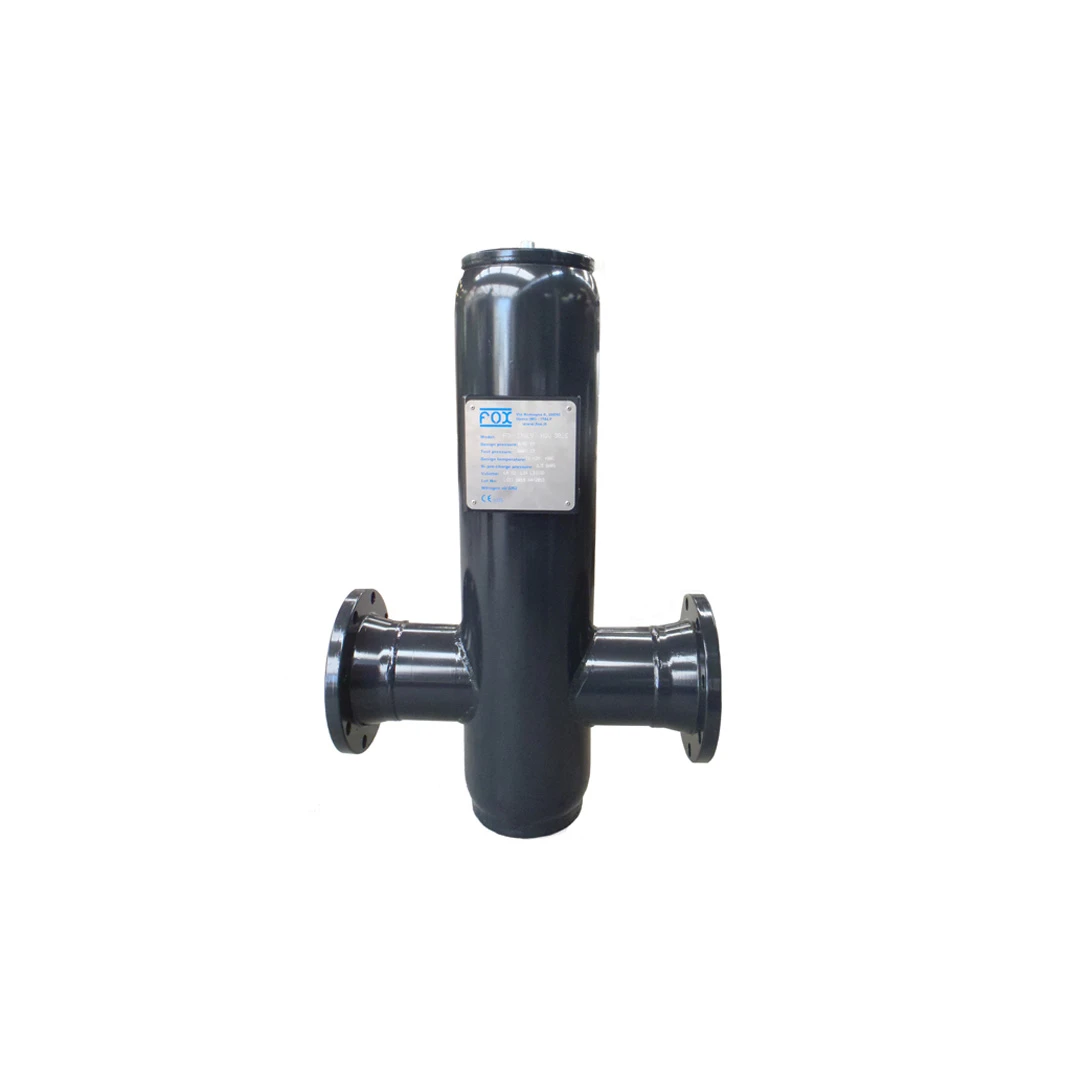
FOX HGV Series Inline Hybrid Bladder – Bellows Pulsation Dampener
The FOX HGV Series Inline Hybrid Bladder – Bellows Pulsation Dampener operates as a low-maintenance flow-through suction stabilizer. This device is typically installed at the suction port of API 674 or API 675 pumps. It is frequently paired with BHP series spherical resonators, which are installed in parallel on the discharge port of the system.
The use of the HGV series, as an alternative to traditional bladder or diaphragm dampeners, provides significant operational advantages. The main benefit lies in its ability to maintain operation even in the event of bladder or bellows failure or rupture; the internal fluid volume is designed to take over and ensure proper system operation without critical shutdowns.
This component is essential for stabilizing suction flow and pressures in pumps subject to high pressure drops, high vapor pressure, and very low NPSHa values. For optimal use, the nitrogen pre-charge pressure must be calculated between 60% and 80% of the actual working pressure, carefully considering the pump specifications and the operating temperature of the fluid.
Engineering flexibility is the key strength of the FOX HGV Series Inline Hybrid Bladder – Bellows Pulsation Dampener, allowing extensive customization according to the system’s project specifications. The standard construction uses AISI 316 L stainless steel, but the dampener body can be manufactured from several high-performance alloys: DSS (Duplex Stainless Steel), SDSS (Super Duplex Stainless Steel), Alloy-20, Hastelloy-C, and carbon steel.
For marine or highly corrosive operating environments, carbon steel can be painted according to strict FOX standard procedures or according to the end user’s specifications. The range of available elastomers is extensive and includes NBR, HNBR, EPDM, FPM, HYTREL, Butyl, Polyurethane, and PTFE. In terms of mechanical life, the number of device cycles is inversely proportional to the increase in the compression ratio.
The HGV series is scalable to support liquid volumes up to 5,000 liters. Process connections, including inlet and outlet flanges, are fully customizable in both type and spatial positioning. The standard configuration provides a 180-degree arrangement, but a 90-degree angle can also be engineered for the outlet flange.
Vents and drains offer the same level of customization; supplied as standard with a blind counterflange, they can be equipped upon request with tie rods, bolts, and spiral-wound gaskets or metallic ring joints suitable for RF or RTJ flanges.
The device ensures sealing for maximum pressures up to 1379 bar, equivalent to 20,000 PSI. The test pressure (PT) is determined by multiplying the nominal pressure (PS) by coefficients of 1.43, 1.3, or 1.5.
Upon specific request, the dampeners can be supplied in full compliance with major international standards: CE (2014/68/EU-PED), ATEX (2014/34/EU), ASME VIII Div.1 or Div.2, U-Stamp + NB, EN 14359, EN 13445, PD5500 (UK), and AS1210/4343 (Australia). Certifications are also available for foreign markets, including KOSHA, SELO, CU-TR 032/2013, DOSH, NR-13, CRN, and ARH, as well as marine approvals such as BV, DNV/RINA, and Lloyd’s/ABS.
Technical summary table of the main characteristics.
| Feature | Value |
|---|---|
| Maximum Pressure | Up to 1379 bar (20,000 PSI) |
| Test Pressure (PT) | PS x 1.43 / 1.3 / 1.5 |
| Liquid Volumes | Available up to 5,000 liters |
| Standard Body Material | AISI 316 L stainless steel |
| Optional Body Materials | DSS, SDSS, Alloy-20, Hastelloy-C, painted carbon steel |
| Available Elastomers | NBR, HNBR, EPDM, FPM, HYTREL, Butyl, Polyurethane, PTFE |
| Connection Configuration | Standard 180 degrees; optional 90-degree angle for outlet flange |
| Pre-charge Pressure | Between 60% and 80% of working pressure |
| Main Applications | Suction side of API 674 / API 675 pumps |
| Model / Series | Specific Product Code | Customization Details |
|---|---|---|
| FOX HGV Series Hybrid Pulsation Dampener | Not specified in the document | Fully customizable component upon specific customer request: volumes, materials, and flanges. |