

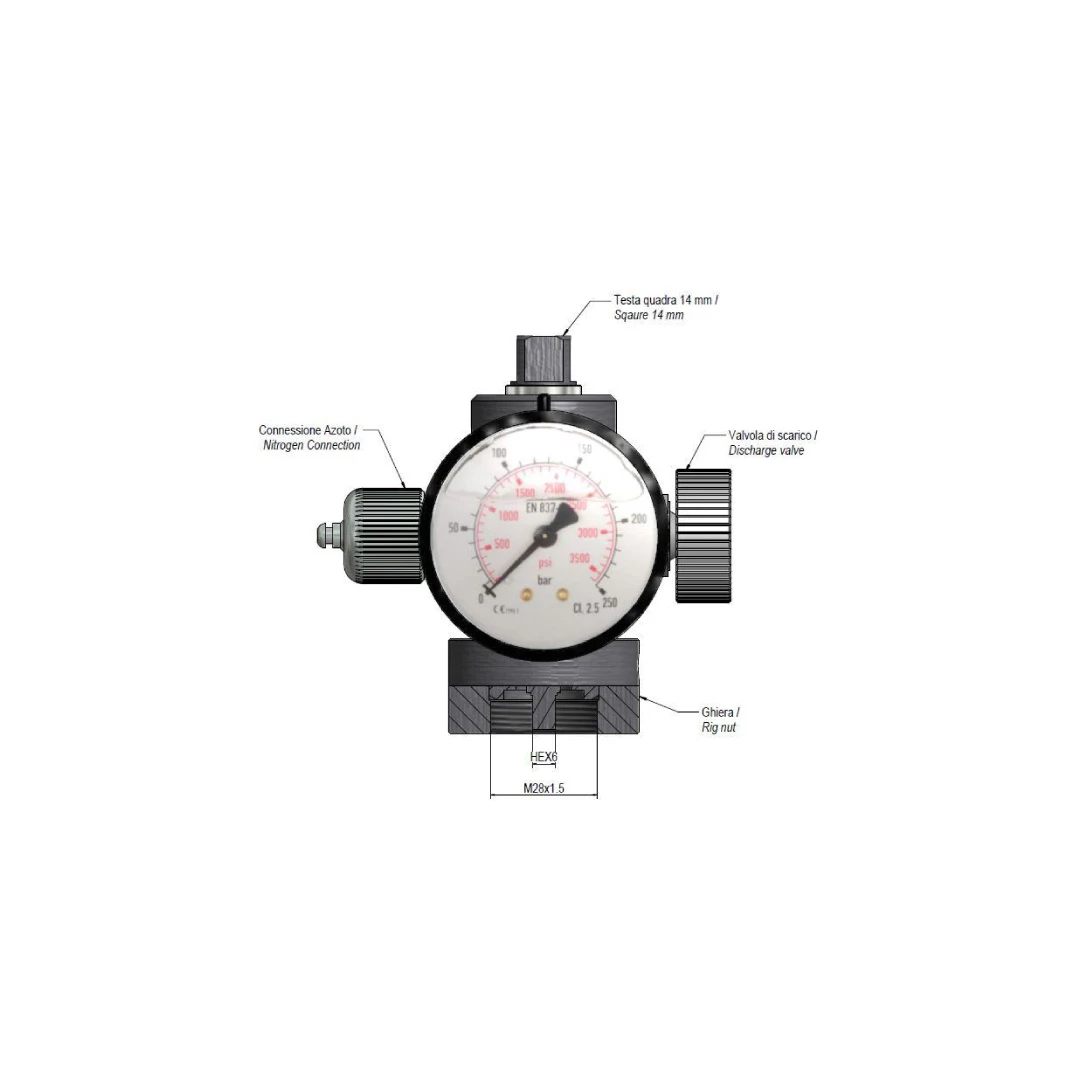
 FOX ARM28 Series Charging and Testing Unit
The FOX ARM28 Series charging and testing unit is an essential technical instrument for the correct management of hydraulic systems. Specifically, this device is designed to perform nitrogen precharge checking, reduction and restoration operations inside accumulators and pulsation dampers with extreme precision. The use of a dedicated system ensures prolonged system efficiency, minimizing risks related to pressure drops or sudden overpressure.
Construction Specifications and Standard Components
From a construction standpoint, the ARM28 Series unit body is entirely manufactured from high-strength steel, surface-treated with trivalent zinc plating. This treatment provides excellent corrosion resistance, making the instrument suitable for demanding industrial environments. The device safely supports a maximum working pressure of up to 1000 bar. The standard version is supplied in a practical dedicated case and includes a series of essential components: an integrated pressure gauge, also available with special units of measurement upon request, a 2.5-metre high-pressure flexible hose, and the operating connections required for the circuit. On the nitrogen cylinder side there is a 3/8″ BSP-F threaded connection, while on the accumulator or damper side a standard M28x1.5 connection is used. To ensure maximum compatibility with various systems, the RID2858 reduction adapter is also available, converting the thread from M28x1.5 to 5/8″ UNF.
Pressure Checking and Reduction Procedures
Accurate pressure checking requires the complete absence of hydraulic load in the circuit containing the accumulator. The operator completely unscrews the upper needle-opening knob before screwing the unit onto the nitrogen valve. Then, by unscrewing the nitrogen discharge valve knob and operating the upper square head, the pressure gauge instantly detects the internal pressure. If the reading shows a zero value despite full opening, the accumulator is completely discharged. To reduce excessive pressure, the knob located on the discharge valve is slowly screwed in until the target value is reached, then unscrewed to allow the valve to close automatically. At the end of the measurements, the operator eliminates the residual pressure inside the equipment by screwing the discharge knob back in, and finally unscrews the entire device.
Nitrogen Charging Guidelines
During the charging operation, the operator inserts the quick coupling connected to the dry nitrogen cylinder before opening the upper needle-opening knob. Gas must be introduced extremely slowly, allowing the elastomeric diaphragm or internal bladder to progressively adapt to the new precharge level without sudden tearing. In terms of operational safety, the use of a pressure reducer installed directly on the nitrogen cylinder outlet is mandatory. Without this shut-off device, an incorrect operation would expose the accumulator to pressure values far above the maximum structural limit, irreparably compromising its functionality and operating integrity. The manufacturer recommends strict periodic precharge checks at regular six-month intervals.
Integration with VM Series Valves
The ARM28 Series unit works in synergy with VM-type nitrogen valves, featuring a galvanized steel body. For naval, chemical or heavy-duty installations requiring higher metallurgical standards, VRMX and VRMXHD variants are available, made entirely of AISI 316L stainless steel. These valves are ideal not only for dampers, but for any gas or fluid system requiring pressure control and air bleeding in closed hydraulic circuits.