


Managing airborne particles and odor emissions is an unavoidable engineering challenge for construction sites, steelworks, and waste treatment facilities.
Ignoring the problem exposes operators to respiratory risks and causes premature wear to machinery due to abrasive dust infiltrating lubricated circuits.
The ultimate technological solution lies in high-pressure misting systems.
The physics of suppression: aerodynamics and collision
Spraying water at low pressure is ineffective. Successful dust suppression depends on agglomerating collision: to capture a fine dust particle (PM10 or PM2.5), the water droplet must be of a similar size.
Imagine a bowling ball being thrown at a ping-pong ball: the mass of air displaced in front of it will push the smaller ball away before impact.
The same phenomenon occurs on a microscopic scale. If a water droplet is too large, the air shock wave deflects the dust, making the suppression process ineffective. Latest-generation cannons overcome this limitation by pressurizing water up to 120 bar and forcing it through calibrated nozzles.
This process breaks the water down into microdroplets ranging from 10 to 50 microns, which collide directly with the particles, aggregate with them, and fall to the ground through gravity without creating mud.
The hydraulic core: pressure, flow rate, and overheating
Atomization requires a constant supply of energy. Advanced systems use ceramic piston pumps, while machine movement, including rotation and tilt, is controlled by hydraulic actuators.
Power is transmitted through the circuits by hydraulic fluids, whose viscosity is crucial. At high operating temperatures, heat drastically reduces the viscosity of the hydraulic oil, limiting its ability to separate moving metal surfaces. This generates sliding friction inside solenoid valves and motors, potentially causing seizure and machine downtime.
Common causes of overheating
Common causes of overheating include prolonged operation at maximum output without rest cycles, pressure drops caused by filters partially clogged with dust, which force the pump to convert wasted energy into heat, and, finally, a low fluid level in the reservoir, which reduces the thermal mass available to dissipate heat.
To prevent thermal failure, these systems incorporate air-to-oil heat exchangers. The high-temperature fluid passes through a coil of finned tubes, while a fan forces cool air across them to remove heat. Keeping these fins free from deposits is essential: a dirty radiator acts as a thermal insulator, pushing the machine toward shutdown.
Machine architecture and configurations
Selecting the right machine requires an analysis of the environment and air volumes involved. The industry offers modular solutions:
- Compact Units: Easy-to-handle systems, such as the Elefantino or Lince ranges, operating at approximately 60 bar and ideal for indoor renovation projects and conveyor belts. They provide localized suppression without causing flooding.
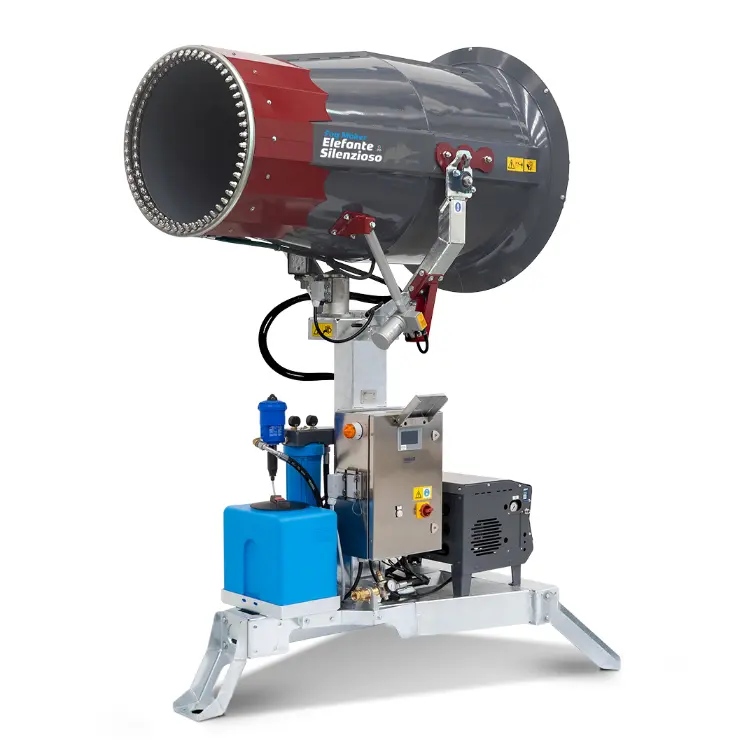
- Heavy-Duty Systems: Designed for quarries and steelworks. Machines such as the Elefante 90 or 120 series project mist up to 90 meters using 120-bar pumping units and more than 130 stainless steel nozzles.
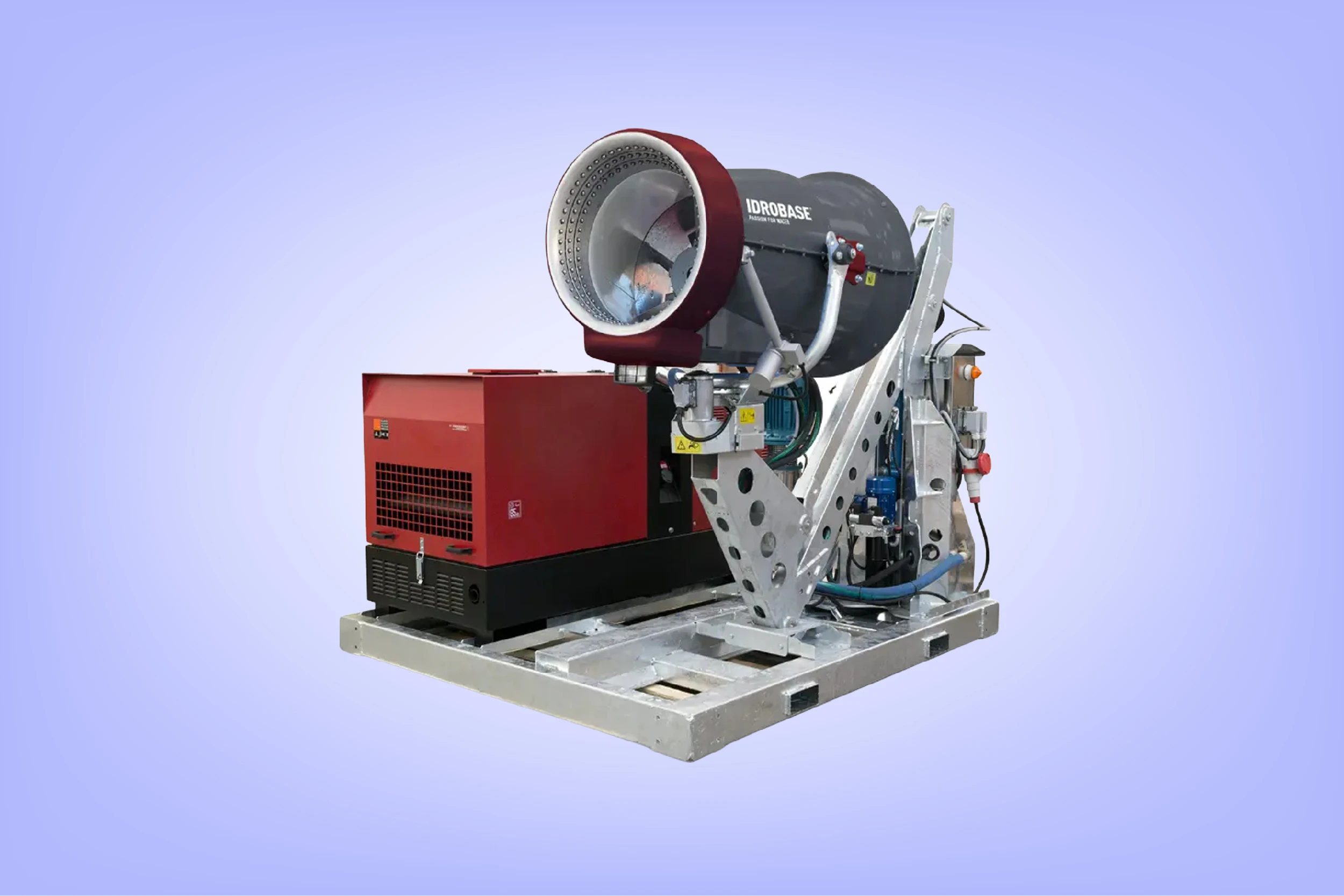
- Self-Contained Systems: Equipped with power generators and integrated water tanks, making them ideal for isolated infrastructure construction sites without access to an electrical connection.
To review technical specifications, flow rates, and rotation options, explore LubeTeam Hydraulic’s dedicated page on Dust and odor suppression cannons, where advanced technology meets the needs of heavy industry.
Applied chemistry: odor neutralization
Landfills and composting facilities face odor emissions caused by volatile organic compounds (VOCs).
These compounds are not suppressed by misted water alone. Advanced cannons incorporate dosing pumps that inject specific biotechnological additives into the water flow.
This approach goes beyond simply masking odors: neutralizing agents trigger chemical reactions that break the molecular bonds of malodorous compounds, converting them into chemically odorless particles.
Predictive maintenance for reliability
The reliability of ultra-high-pressure machinery depends on predictive maintenance. A reactive approach generates unacceptable financial losses.
- Cavitation Prevention. Cavitation occurs when the water supply to the pump is insufficient, for example because of clogged filters. The pressure drops, causing the water to boil at room temperature and generate microscopic vapor bubbles. When compressed at 120 bar, these bubbles implode, damaging the ceramic pistons and eroding metal components. Preventing cavitation requires in-line pressure gauges and meticulous filter cleaning.
- Nozzle Protection. If the intake water is hard or contains high levels of sediment, the nozzles can be damaged rapidly. Limescale blocks the opening and alters the spray cone, while suspended sand projected at 120 bar erodes the metal, enlarging the opening and producing droplets that are too heavy to suppress dust. Multi-stage pre-filtration systems ensure consistently efficient atomization.
Return on investment
Implementing high-pressure misting machinery goes beyond regulatory compliance. It protects workforce health and delivers a clear technical return on investment by reducing wear-related costs across the machinery fleet. By neutralizing dust at its source, air filters become clogged less frequently, hydraulic oils remain clean, and radiators avoid dangerous overheating. Correct system sizing and rigorous maintenance transform critical sites into safe and efficient facilities.