


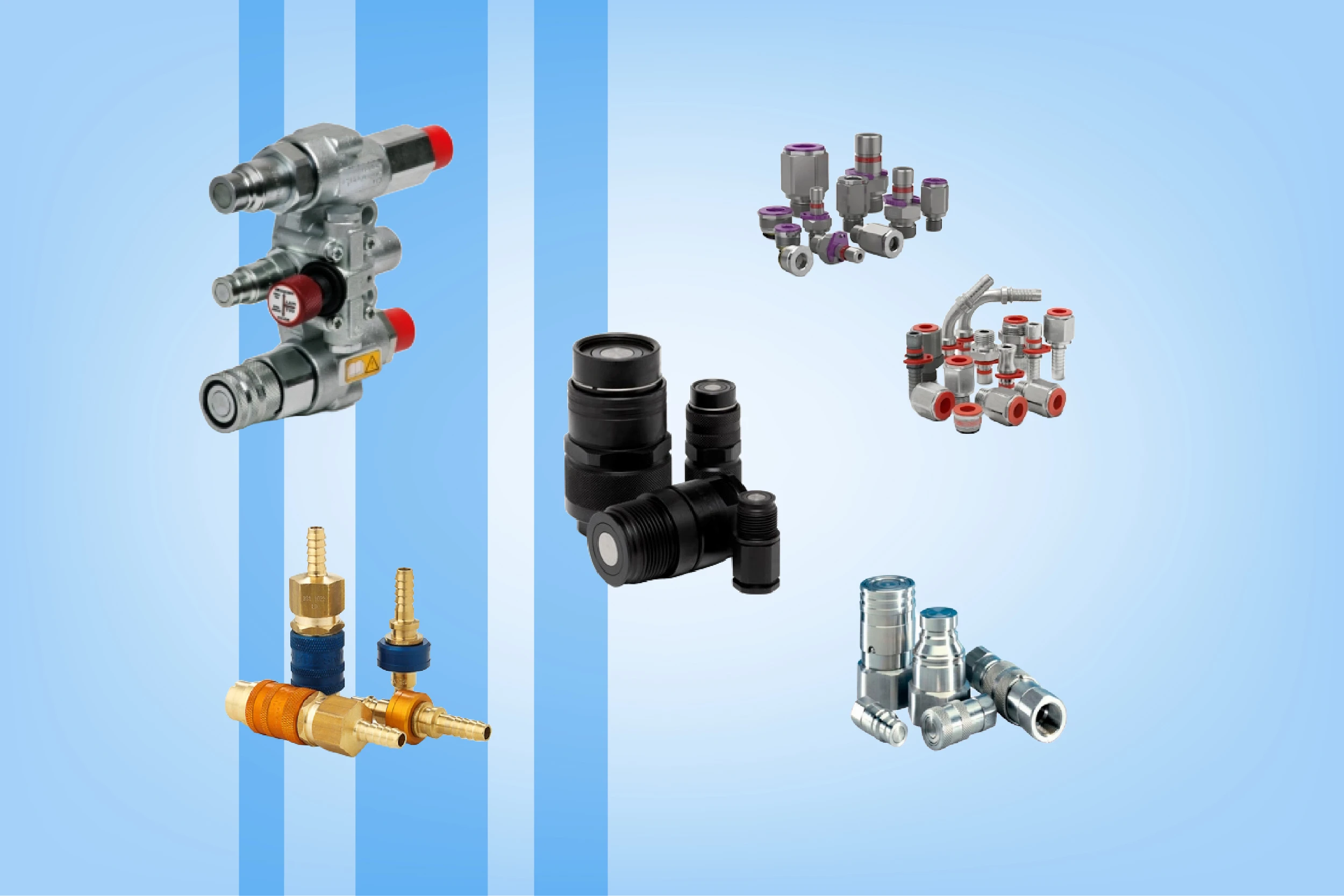
Hydraulic quick-release couplings play an essential role in hydraulic systems, allowing hoses, equipment, and components to be connected and disconnected quickly, conveniently, and safely. Their use simplifies maintenance operations, reduces intervention times, and contributes to the reliability of hydraulic circuits.
In industrial applications, even a simple connection can affect the performance of an entire system. An inadequate connection can cause fluid leaks, contamination, pressure drops, and operational interruptions, with consequences for productivity and operating costs.
Choosing safe hydraulic quick-release couplings therefore requires careful consideration of technical specifications, operating conditions, and compatibility with other system components.
What Are Hydraulic Quick-Release Couplings and How Do They Work?
Hydraulic quick-release couplings, also known as hydraulic quick couplings, allow temporary or frequently detachable connections between two parts of a hydraulic circuit without having to disassemble conventional fittings each time.
A quick coupling generally consists of two complementary elements: a male half and a female half. When the operator connects the two components, the coupling mechanism opens the internal valves, allowing fluid to flow through the connection.
During disconnection, the valves integrated into both halves, where provided, shut off the oil flow and limit fluid leakage.
The operating principle relies on three fundamental elements:
- Locking system: keeps the two halves securely connected during operation and helps prevent accidental disconnection.
- Sealing mechanism: uses seals and mating surfaces to contain the hydraulic fluid.
- Internal valves: control oil flow during connection and disconnection operations.
The effectiveness of the connection depends on the coupling’s manufacturing quality, compatibility between the two halves, and compliance with the operating conditions specified by the manufacturer.
Why Quick Couplings Are Important for Hydraulic System Safety
A hydraulic circuit transfers energy through a fluid that can reach high pressures. Under these conditions, every connection represents a point that requires particular attention.
Quick couplings contribute to system safety when they provide adequate sealing and maintain a stable connection under the intended operating conditions.
Preventing Hydraulic Oil Leaks
Fluid leaks compromise system efficiency and can increase maintenance costs. At high pressures, even a seemingly minor leak can pose a significant risk to operators.
Quick couplings equipped with automatic shut-off valves reduce the amount of oil released during disconnection.
Flat-face couplings offer an additional advantage by minimizing the volume of fluid exposed in the mating area.
However, it is important to distinguish between minimizing leakage during disconnection and the ability to disconnect under pressure. Only devices specifically designed and approved by the manufacturer permit certain operations in the presence of residual pressure.
Protecting Hydraulic Fluid from Contamination
Oil contamination is one of the main causes of wear and malfunction in hydraulic components.
Dust, water, and solid particles can enter the circuit during connection operations, especially when equipment operates outdoors or in particularly demanding environments.
Quick couplings designed to minimize contamination make it easier to clean contact surfaces and reduce the likelihood of foreign substances entering the hydraulic circuit.
This feature is particularly important in systems that use pumps, directional control valves, and other valves with tight manufacturing tolerances, where even small particles can compromise proper operation.
Main Types of Hydraulic Quick-Release Couplings
The market offers various quick-coupling configurations, each designed to meet specific operational requirements.
The main distinctions concern the shut-off system, valve geometry, and connection method.
Poppet Valve Quick Couplings
Poppet valve quick couplings use internal valve elements that open when the two coupling halves are connected.
This configuration is widely used in industrial and agricultural applications thanks to its straightforward operating principle and availability in different sizes and configurations.
During disconnection, however, the valve geometry may retain a small amount of oil and make the surfaces more difficult to clean compared with flat-face versions.
The choice therefore depends on the system characteristics, connection frequency, and required cleanliness standards.
Flat-Face Hydraulic Quick Couplings
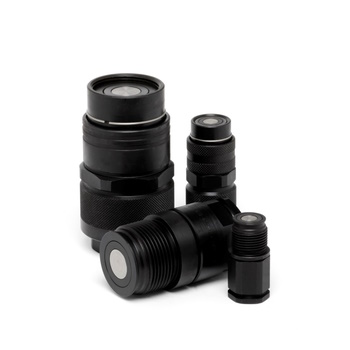
Flat-face quick couplings feature substantially flat mating surfaces.
This design allows the coupling ends to be cleaned quickly before connection and minimizes oil leakage when the two halves are separated.
These characteristics make flat-face couplings particularly suitable for earthmoving machinery, interchangeable attachments, and applications involving frequent connections.
The ISO 16028 standard defines interface dimensions and performance requirements for certain categories of flat-face hydraulic quick-action couplings, promoting interchangeability between compliant components.
However, dimensional compliance does not automatically guarantee equivalent performance. Pressure ratings, flow capacity, materials, and seal characteristics must always be verified.
Quick Couplings for Connection Under Residual Pressure
In some applications, hydraulic circuits may retain residual pressure even after the machine has been shut down.
This phenomenon may result from fluid trapped inside hoses or from temperature increases that cause the oil to expand within an enclosed volume.
Under these conditions, conventional couplings can become difficult or impossible to connect.
To address this issue, some manufacturers develop specific versions that allow connection under defined levels of residual pressure.
These solutions still require verification of the operating conditions permitted by the manufacturer and do not automatically authorize disconnection of a pressurized circuit.
How to Choose Safe and Efficient Hydraulic Quick-Release Couplings
Selecting a quick coupling should not be based solely on connection diameter or its resemblance to a component already installed.
It is essential to assess the characteristics of the entire hydraulic circuit and identify the most demanding operating conditions.
Operating Pressure and Mechanical Strength
Pressure is one of the first parameters to consider.
Every quick coupling has pressure limits that depend on its model, size, materials, and configuration.
The component must withstand the maximum pressure expected in the application, including potential transient pressure spikes and dynamic loads.
It is essential to distinguish maximum working pressure from burst pressure. Burst pressure indicates a mechanical resistance limit established through testing and is not an allowable value for normal operation.
Flow Rate and Pressure Drop
Flow rate indicates the volume of fluid passing through a component per unit of time.
A quick coupling with an insufficient internal flow passage can restrict oil flow, resulting in a pressure drop.
Part of the hydraulic energy is consequently converted into heat, contributing to increased fluid temperature and reduced overall circuit efficiency.
For this reason, proper sizing must consider not only the nominal coupling size but also the actual flow rate and the pressure-drop curves provided by the manufacturer.
Temperature, Viscosity, and Material Compatibility
Temperature conditions influence the behavior of hydraulic oil and seals.
As temperatures decrease, many hydraulic oils become more viscous and encounter greater resistance when flowing through components.
As temperatures increase, viscosity generally decreases, while seals may be exposed to different types of stress.
It is therefore essential to verify compatibility between the hydraulic fluid, metallic materials, and elastomers, as well as the coupling’s specified temperature limits.
Proper selection helps prevent premature deterioration and maintain reliable sealing performance over time.
Installation and Maintenance of Hydraulic Quick Couplings
Even a technically suitable component can develop problems if installation or maintenance procedures do not comply with the manufacturer’s instructions.
Regular inspections help identify signs of wear before they lead to failures or operational downtime.
Best Practices for Reliable Connections
Before making a connection, the operator must check the condition of the circuit and follow the equipment’s specified depressurization procedure.
It is also advisable to:
- Thoroughly clean the mating surfaces.
- Inspect seals and locking mechanisms for damage.
- Verify compatibility between the male and female coupling halves.
- Avoid excessive pulling forces, twisting, and improper mechanical stress on hoses.
- Use protective caps and plugs when couplings are disconnected.
After connection, the operator must verify that the locking mechanism has fully engaged.
Operators must never use their hands to locate leaks in a pressurized system: a fine jet of hydraulic oil can penetrate the skin and cause serious injuries.
Warning Signs That Indicate the Need for Inspection
Connection difficulties, recurring leaks, deformation, corrosion, and surface wear are warning signs that require inspection.
An abnormal temperature increase or a reduction in performance may also indicate a restriction in the internal flow passage, although these symptoms can originate from other parts of the circuit.
Maintenance activities should identify the actual cause of the problem before replacing the component.
When a coupling shows structural damage or sealing problems, it is essential to follow the manufacturer’s recommendations and use compatible replacement parts.
Industrial Applications of Hydraulic Quick-Release Couplings
Quick couplings are widely used in applications where operators need to connect and disconnect sections of a hydraulic circuit frequently.
In the earthmoving equipment sector, they facilitate the replacement of hydraulic tools and attachments, reducing the time required to reconfigure machinery.
In the manufacturing industry, they enable temporary connections during maintenance operations, functional testing, and system reconfiguration.
Agricultural machinery frequently uses quick couplings to connect hydraulic implements to tractors, while mobile hydraulic applications require components capable of withstanding vibrations, changing environmental conditions, and repeated connection cycles.
Across all these sectors, proper quick-coupling selection helps minimize machine downtime and maintain reliable operating conditions.
LubeTeam Hydraulic Solutions for Hydraulic Quick-Release Couplings
LubeTeam Hydraulic offers a range of Hydraulic Quick-Release Couplings designed to meet the connection requirements of hydraulic circuits across various industrial applications.
The product portfolio includes solutions from CEJN and Stucchi, manufacturers specializing in the development of connection systems for hydraulic applications.
CEJN couplings feature technologies designed to combine safety, ease of use, and fluid leakage control. The available configurations allow customers to evaluate solutions based on pressure conditions, flow requirements, and specific application needs.
Stucchi solutions include quick couplings for industrial and mobile applications, with configurations designed to minimize fluid leakage and enable connection under residual pressure, in accordance with the specifications of each product series.
Selecting the right component always requires comparing the hydraulic system’s operating characteristics with the product’s technical specifications.
Choosing the most suitable quick coupling means protecting your hydraulic system, simplifying maintenance, and improving operational continuity. To explore the available solutions and identify the most appropriate configuration, contact LubeTeam Hydraulic.