


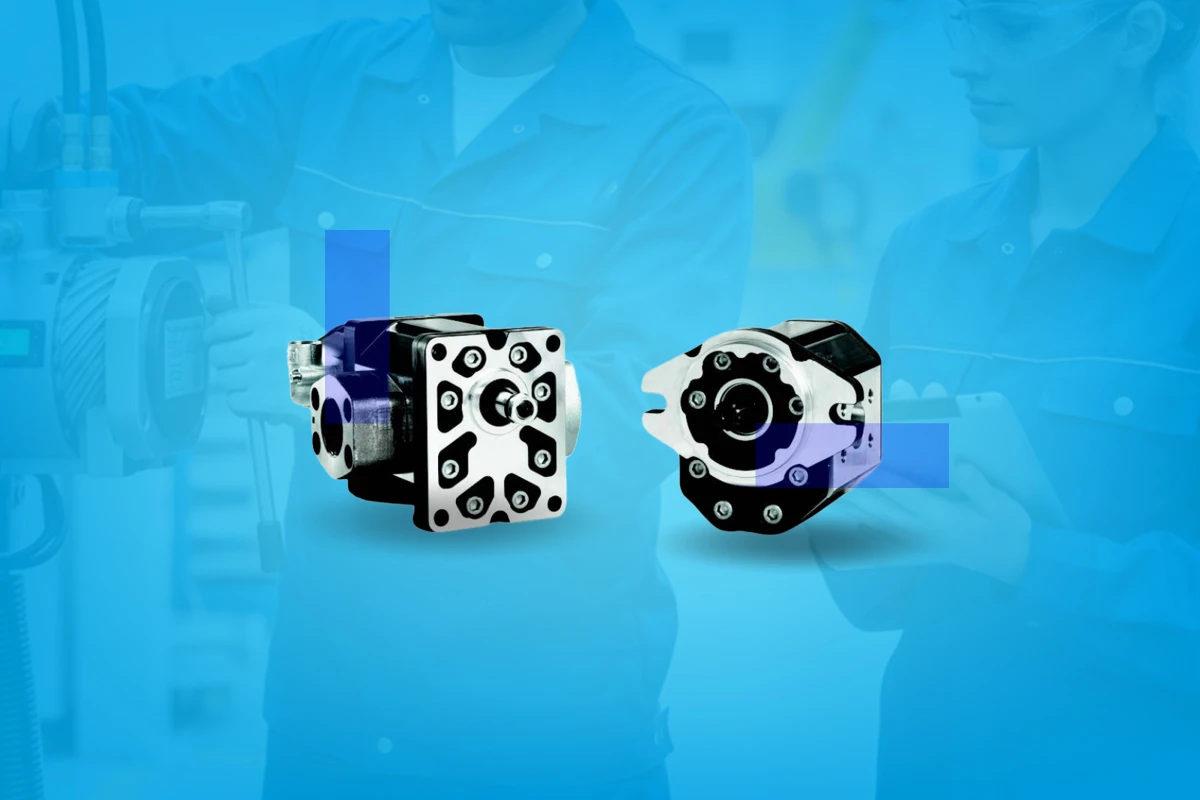
Noise is not just a nuisance. In modern hydraulic systems, noise signals inefficiencies, non-optimized mechanical stresses, vibrations that accelerate wear, and operating conditions that reduce the overall reliability of the plant. In this context, silence becomes a technical indicator of design quality and a true competitive factor.
Marzocchi Elika motors were created to meet this very real need. They do not reduce noise as a side effect, but address it as a primary engineering goal. The result is a solution that improves the working environment, increases system precision, and protects the investment over the long term.
Why noise in hydraulic motors is a technical problem, not just an acoustic one
The noise generated by a hydraulic motor mainly comes from three factors: flow pulsations, discontinuities in power transmission, and structural vibrations. In traditional external gear motors, gear meshing creates cyclical volume variations that translate into pressure waves. These waves propagate along the circuit, stressing pipes, valves, and mechanical components.
Noise, therefore, does not remain confined to the motor. It amplifies system vibrations, accelerates the loosening of fittings, increases the risk of micro-leaks, and reduces control stability. In high-precision applications, such as machine tools, servo-assisted presses, or automated industrial plants, this phenomenon compromises process quality.
Reducing noise means tackling the root of the problem: making motion more continuous, pressure more stable, and flow more uniform. This is exactly the principle behind Elika technology.
Elika technology: how the helical gear profile works
The key difference between an Elika motor and a traditional gear motor lies in its geometry. Elika gears feature a helical profile that ensures progressive and continuous tooth contact. This eliminates the sudden impact typical of straight-tooth gears.
The most effective analogy is that of a human step. Placing the foot gradually on the ground generates less stress than a sharp jump. In the same way, helical meshing distributes the load over a larger surface and in a progressive manner.
This solution produces three fundamental technical effects:
- drastic reduction of flow pulsations
- suppression of structural vibrations
- stabilization of pressure in the circuit
The motor operates in a smooth, steady, and predictable way. Silence becomes a direct consequence of mechanical efficiency.

Operational silence and system precision
In modern hydraulic systems, the motor never works alone. It interacts with proportional valves, sensors, actuators, and electronic control systems. In this ecosystem, flow stability is a critical requirement.
A noisy motor generates fluctuations that make the work of control systems more complex. By contrast, a silent motor like Elika delivers a constant flow that simplifies control and increases motion accuracy.
This aspect is crucial in applications such as:
- CNC machine tools
- high-speed packaging lines
- industrial handling systems
- precision presses
- machinery for the wood and plastics industries
Noise reduction translates directly into more stable movements, process repeatability, and higher quality of the finished product.
Benefits for component life and maintenance
Noise is a form of wasted energy. Where there is noise, there is friction, stress, and wear. Eliminating noise means reducing mechanical stress on every component in the circuit.
Marzocchi Elika motors reduce:
- gear wear
- shaft stresses
- vibrations transmitted to the machine structure
- premature seal degradation
This greater mechanical stability extends the service life of the motor and the entire hydraulic system. Maintenance intervals become longer, downtime is reduced, and the total cost of ownership decreases in a measurable way.
From an industrial perspective, silence becomes an ally of production continuity.
Energy efficiency and operational sustainability
A noisy system wastes energy. Pressure pulsations require continuous compensation, increase internal losses, and reduce the overall efficiency of the circuit.
Thanks to flow continuity, Elika motors operate more efficiently. Hydraulic energy is converted into mechanical work with fewer losses. This results in:
- lower energy consumption
- less heat generation
- greater thermal stability of the oil
A system that runs at lower temperatures preserves the fluid’s properties better, reduces oxidation, and keeps performance consistent over time. From a sustainability standpoint as well, silence becomes a responsible technical choice.
Industrial applications where silence makes the difference
Not all production environments require the same level of attention to noise. However, there are sectors where silence is a functional, regulatory, or competitive requirement.
These include:
- indoor environments with operators present
- high-density production lines
- plants with acoustic comfort requirements
- medical or food-processing applications
- machines destined for markets with strict regulations
In these contexts, adopting the Marzocchi Elika Motors M-ELI 1 / M-ELI 2 makes it possible to design more advanced systems without having to rely on corrective solutions such as sound-proofing enclosures or additional dampers.
Integration with modern hydraulic system design
Modern hydraulics no longer focuses only on power. It focuses on integration. Elika motors fit perfectly into this vision thanks to their compatibility with:
- proportional systems
- advanced electronic controls
- compact architectures
- high-energy-efficiency systems
Noise reduction also simplifies machine design. The designer no longer has to compensate for vibrations or fluctuations, but can focus on functionality and layout optimization.
In this sense, silence speeds up development and reduces design risk.
Why silence is a real competitive advantage
In the B2B market, competitive advantage does not come from a single feature, but from the sum of tangible benefits. Marzocchi Elika motors turn silence into industrial value because they:
- improve system reliability
- increase control accuracy
- reduce maintenance costs
- improve the working environment
- strengthen the machine’s technological image
A silent system communicates quality even before it starts operating. In a market increasingly focused on efficiency, sustainability, and operational well-being, this factor becomes decisive.