


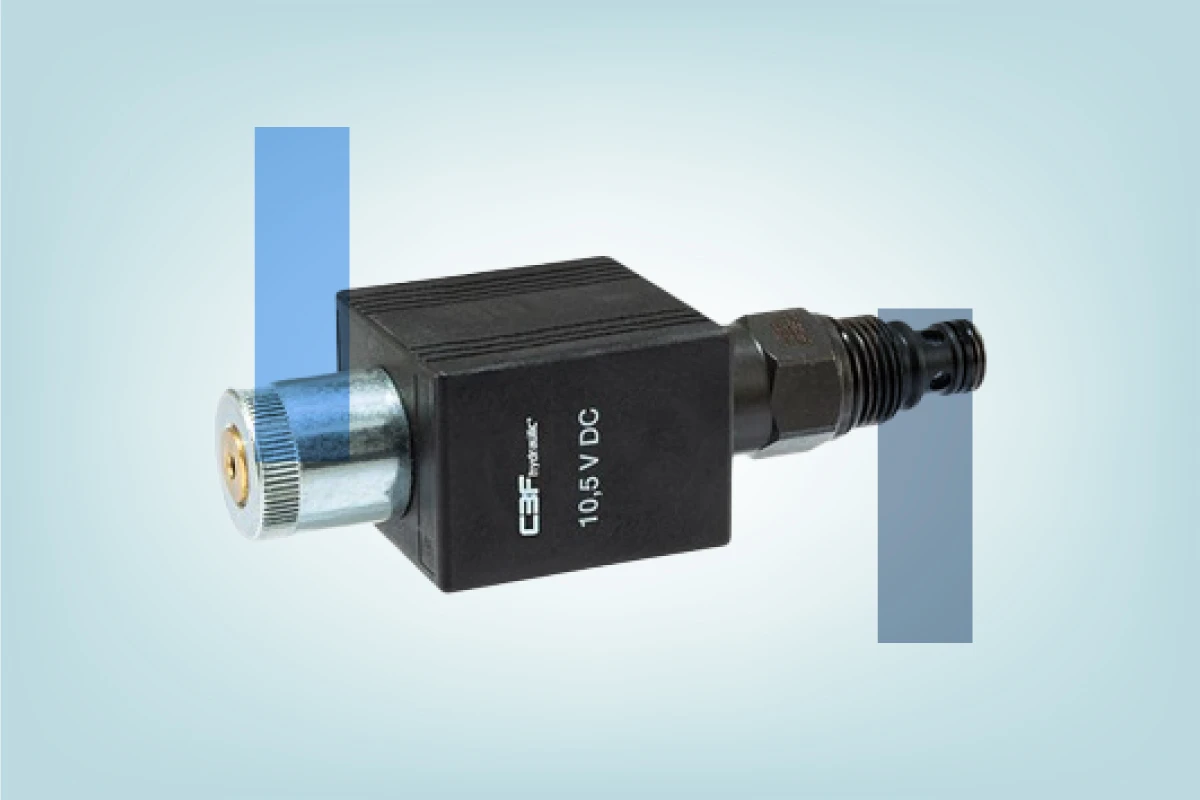
Precise control of speed, force, and position is now one of the key distinguishing factors in advanced hydraulic systems. Machines must no longer simply move: they must do so in a controlled, smooth, and repeatable way.
Proportional valves were developed to meet this need. Unlike traditional on/off valves, which operate in a fully open or fully closed mode, proportional valves continuously regulate fluid flow and pressure.
This makes it possible to transform a hydraulic system from “reactive” to “controlled,” introducing a level of precision that until a few years ago could only be achieved with more complex electromechanical solutions.
The limitation of traditional valves in dynamic systems
Conventional directional valves function like switches: they open or close the passage of fluid. This logic is sufficient for simple applications, but becomes a limitation when progressive control is required.
An actuator controlled by an on/off valve tends to move abruptly. Startup is sudden, speed is difficult to modulate, and stopping can generate hydraulic shocks.
In applications such as machine tools, presses, lifting systems, or advanced mobile machinery, this lack of control results in reduced precision, increased wear, and lower process quality.
How proportional valves work
Proportional valves regulate flow based on a continuous electrical signal. The higher the signal, the greater the valve opening.
It is useful to imagine their behavior as that of an adjustable tap: it is not simply open or closed, but has infinite intermediate positions that determine how much water flows.
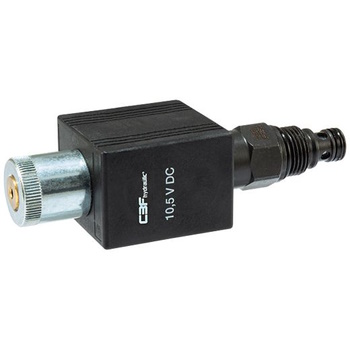
Inside the valve, a proportional solenoid converts the electrical signal into mechanical force that moves a spool. This movement controls the fluid passage section, modulating flow rate and pressure.
To explore available solutions, you can consult the proportional valves designed for high-performance industrial and mobile applications.
Flow and pressure control: the real added value
Proportional valves make it possible to continuously regulate two fundamental variables: flow rate and pressure.
Flow control translates into managing actuator speed. A cylinder can advance slowly for precision operations and accelerate when accuracy is not required.
Pressure control, on the other hand, makes it possible to modulate the applied force, avoiding overloads and improving work quality.
This dual capability makes proportional valves extremely versatile and suitable for complex systems.
Typical applications in modern hydraulic systems
Proportional valves are used in all contexts where fine motion control is required.
In machine tools, they enable precise and repeatable machining. In presses, they regulate the applied force according to the material. In mobile systems, they improve maneuverability and operating comfort.
In the agricultural sector and in working machinery, they enable smoother and more controlled movements, reducing operator fatigue and increasing productivity.
Interaction with electronics: towards intelligent systems
The real leap in performance of proportional valves emerges when they are integrated with electronic control systems.
Electronic control units, sensors, and software make it possible to adjust the signal in real time, adapting system behavior to operating conditions.
This makes it possible to implement advanced logics such as position control, load compensation, and automatic cycle management.
The hydraulic system thus becomes part of an intelligent ecosystem capable of optimizing performance and reducing consumption.
Stability and precision: managing oscillations
One of the main advantages of proportional valves is their ability to reduce oscillations and instability.
In traditional systems, load variations can cause irregular movements. Proportional valves, thanks to continuous regulation, maintain control even under variable conditions.
This improves work quality and reduces stress on mechanical components.
Energy efficiency and loss reduction
A system that always operates at maximum pressure consumes energy even when it is not necessary. Proportional valves make it possible to adapt pressure to the actual operational requirement.
This reduces energy losses and limits heat generation. Lower overheating means longer oil and component life.
Efficiency is not only a matter of consumption, but also of long-term reliability.
The role of oil: viscosity and dynamic response
The behavior of proportional valves also depends on the characteristics of the hydraulic fluid.
Oil viscosity affects response speed and control stability. Oil that is too viscous slows movement, while oil that is too fluid can reduce precision.
It is useful to imagine the oil as the medium through which the valve “signal” travels. If the fluid is not in the correct condition, even the best control system loses effectiveness.
Contamination and system reliability
Proportional valves have much tighter tolerances than traditional valves. This makes them more sensitive to contamination.
Solid particles or impurities can compromise spool movement, causing malfunctions or loss of precision.
An adequate filtration system and regular maintenance are essential to ensure consistent performance.
Common mistakes in selection and use
One of the most frequent mistakes is underestimating the complexity of proportional valves. They are not simply a direct replacement for a traditional valve.
Selection must consider parameters such as system dynamics, compatibility with electronics, and operating conditions.
Another mistake concerns improper calibration. Without correct adjustment, even a high-quality proportional valve may fail to deliver the expected results.
Maintenance and diagnostics
Maintenance of proportional valves requires a more careful approach compared to standard valves.
Performance monitoring, verification of electrical signals, and checking oil quality help identify potential anomalies.
Preventive diagnostics make it possible to intervene before failures occur, avoiding downtime and unexpected costs.
The future of hydraulics lies in proportional control
The evolution of hydraulics follows a clear direction: greater control, higher efficiency, and increased integration with digital systems.
Proportional valves represent one of the pillars of this transformation. They make it possible to achieve high performance while maintaining the robustness and power typical of hydraulic systems.
Investing in these technologies means preparing your system for future requirements, improving competitiveness and sustainability.
Precision and control as a competitive advantage
Proportional valves are not simply a technical evolution, but a paradigm shift in the way hydraulic systems are designed and managed.
They provide continuous control, greater efficiency, and superior operational quality. They make it possible to adapt the system to real needs, reducing waste and improving productivity.
In an increasingly demanding industrial context, the ability to control every variable becomes a concrete competitive advantage.