


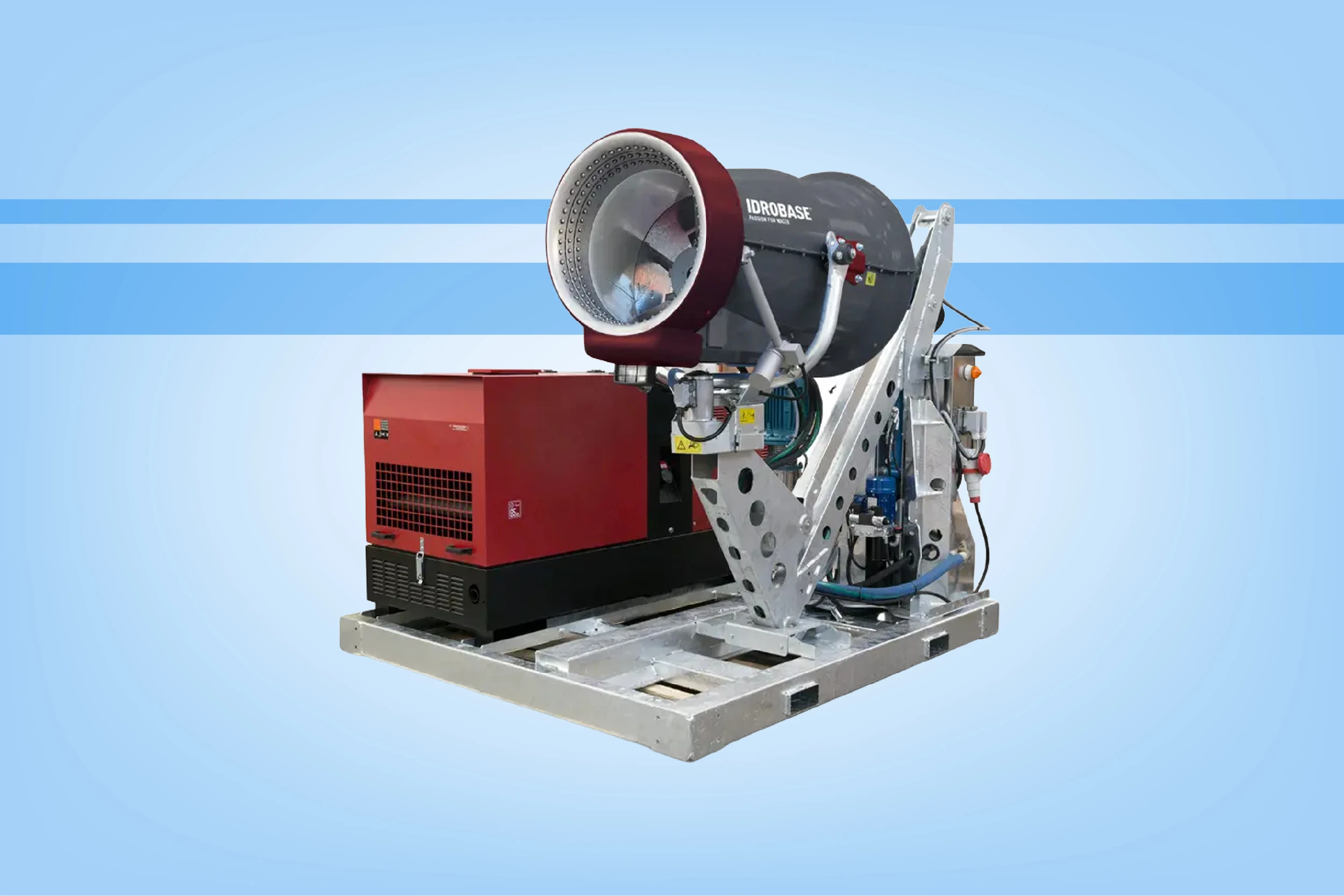
Fine dust, airborne material and particulate matter represent a significant challenge in construction sites, quarries, waste treatment plants, cement plants, steelworks and facilities handling bulk materials. Limiting dust dispersion requires much more than simply wetting surfaces: particles must be captured at the point where they are generated and prevented from spreading into the surrounding environment.
Dust suppression cannons are specifically designed for this purpose. They generate a mist of microdroplets and project it towards the dust cloud through a controlled airflow. The water comes into contact with suspended particles, increasing their mass and causing them to settle.
However, efficiency does not depend solely on the amount of water used or on the throw range specified by the manufacturer. An effective system results from the correct balance between droplet size, pressure, flow rate, nozzle characteristics, airflow, distance from the source and environmental conditions.
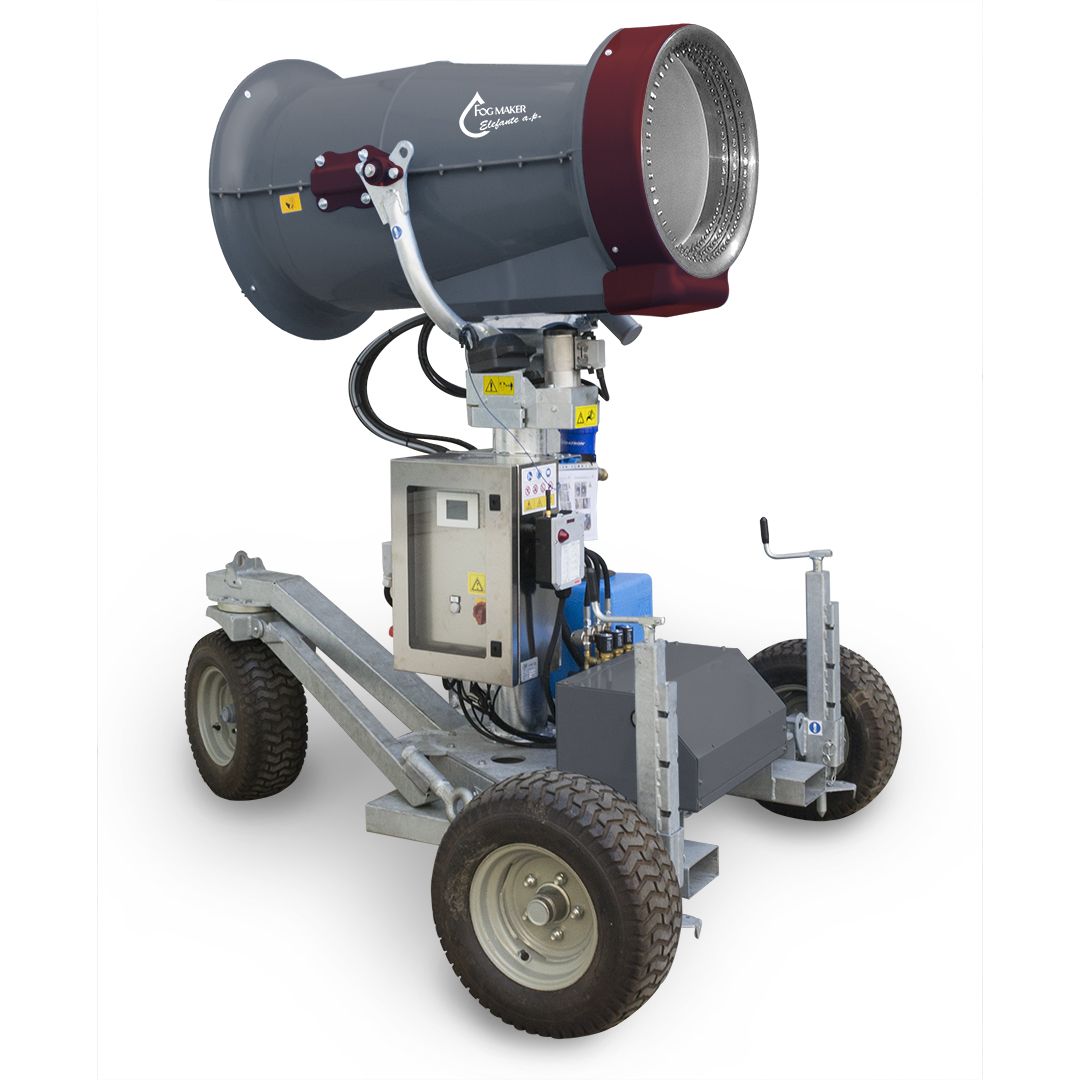
How Dust Suppression Cannons Work
The physical principle behind dust suppression appears simple: a water droplet intercepts a dust particle, captures it or adheres to it, creating a heavier aggregate that can no longer remain easily suspended in the air.
The process becomes effective only when the system produces droplets whose size is compatible with that of the particles to be captured.
An excessively large droplet may pass through a dust cloud without efficiently capturing the finest particles. Air currents developing around the droplet can, in fact, carry particulate matter along trajectories that prevent direct impact.
Finer atomisation, on the other hand, increases the number of droplets generated from the same volume of water and creates a significantly larger overall contact surface. For airborne dust suppression, technical literature highlights the importance of matching droplet size to particle size, as well as correct nozzle positioning and spray geometry.
Pressure and Droplet Size
The pump brings the water to the required pressure, while the nozzles transform the continuous flow into a controlled distribution of microdroplets.
Increasing pressure, within the operating limits of the system, can allow the nozzles to produce finer atomisation. However, pressure is not a parameter that should be maximised indiscriminately. It must work in combination with flow rate, nozzle geometry and the volume of air generated by the fan.
An oversized system may consume more energy and water without achieving a proportional improvement in dust suppression performance.
The Role of Airflow
The fan does more than simply increase the throw range. It creates the airflow that carries the mist towards the point where dust is generated.
The system designer must therefore assess air velocity, distance from the emission point, source height and wind conditions.
A nominal throw range of 80 or 90 metres does not automatically mean that the cannon is the best solution for every area within that distance. The airflow must reach the particulate cloud while still providing a droplet distribution capable of effectively capturing the dust.
Main Components of an Industrial Fog Cannon
A dust suppression cannon integrates several subsystems that must operate in a coordinated manner.
Pump Unit
The pump maintains sufficient pressure and flow rate to supply the nozzles evenly. In high-pressure systems, components such as heavy-duty pump heads and wear-resistant pistons help ensure continuous operation.
Irregular water supply, on the other hand, causes variations in the spray pattern and reduces atomisation quality.
Nozzles
Nozzles are among the most important components of the entire system. Orifice diameter, material, spray angle and distribution around the nozzle ring determine both the quantity and characteristics of the droplets produced.
Depending on the model, LubeTeam Hydraulic offers configurations equipped with numerous stainless-steel nozzles and operating pressures of up to 120 bar.
Water Filtration System
Sediment, sand and limescale can quickly compromise nozzle performance. A partially blocked orifice changes the spray cone, while an eroded orifice increases the jet diameter and alters the flow rate.
Filtration should therefore not be considered a secondary accessory, but rather an essential requirement for maintaining consistent performance.
Fan and Air Conveyor
The fan generates the airflow that carries the microdroplets. The air conveyor concentrates this flow and influences the system’s throw range.
Fan power and airflow rate must be appropriate for the area to be treated. A machine designed for a small unloading area requires very different specifications from a unit intended for a quarry or a large industrial yard.
Oscillation and Tilt
Horizontal rotation and vertical tilt allow the system to follow the dust source and increase the area covered.
Automatic systems make it possible to set operating angles and repetitive cycles. In models using hydraulic actuators, the hydraulic circuit controls heavy movements with precision and continuity.
How to Size a Dust Suppression Cannon
The selection process should not begin with the question “How many metres can it reach?”, but with the nature of the problem that needs to be solved.
Type and Source of Dust
The first step is to identify exactly where the particulate matter is generated.
A discharge point on a conveyor belt creates a localised source. Demolition work, on the other hand, produces emissions whose position changes as operations progress. A yard exposed to continuous vehicle traffic generates dust across a much wider surface area.
Each scenario requires a different positioning strategy.
The characteristics of the material also matter. Mineral dust, cement, aggregates, metallic residues and organic materials all have different particle size distributions and behaviours.
Required Effective Throw Range
The throw range must allow the mist to reach the source without forcing the machine to operate constantly at its maximum limit.
An operating margin makes it possible to compensate for changes in wind conditions, material movement and variations in the organisation of the working area.
For large industrial sites, installing several correctly positioned units may be more effective than relying on a single high-powered cannon to cover the entire area.
Available Water Flow Rate
A machine may offer excellent theoretical performance but prove unsuitable if the site cannot provide the required water flow rate.
Before selecting the system, it is necessary to assess water availability, supply pressure, water quality, the presence of storage tanks and filtration capacity.
The flow rate must also be compatible with the process. Using more water than necessary can create pooling, mud or problems when handling materials.
Fixed, Mobile or Self-Contained Installation
A fixed installation works well when the dust source remains stable over time.
Trailer-mounted configurations, on the other hand, allow the machine to be moved quickly between different operating areas.
When the site does not provide an adequate electrical supply, a self-contained system with an integrated generator makes it possible to operate even in remote areas. The range offered by LubeTeam Hydraulic includes compact, trailer-mounted, fixed and self-contained solutions designed for a wide variety of applications.
Dust Suppression Cannons for Construction Sites and Demolition
Demolition operations generate large quantities of airborne material over very short periods of time. In addition, the emission point changes as the work progresses.
A mobile cannon can follow the excavator or the active working area and direct the mist straight towards the dust cloud.
The operator should avoid positioning the system too far from the source. Acting close to the emission point reduces the time available for dust to disperse and allows water to be used more efficiently.
Quarries, Mines, Cement Plants and Bulk Material Handling
Heavy-duty applications require wider coverage and equipment capable of operating in harsh environments.
In these applications, the system must cope with continuous dust generation, vibration, abrasive materials and prolonged duty cycles.
In these environments, the system designer should primarily assess:
- distance between the machine and the dust source;
- prevailing wind direction;
- height of material stockpiles;
- loading and unloading points;
- frequency of production cycles;
- need for automatic oscillation;
- availability of water and electrical power.
The range available through LubeTeam Hydraulic also includes units with throw ranges of up to 75–90 metres and systems capable of operating at high pressures. The Fog Maker Elefante 90, for example, offers a specified throw range of up to 90 metres and uses 135 nozzles, with several installation configurations available.
PM10 and PM2.5 Suppression
PM10 and PM2.5 refer to particles with aerodynamic diameters of less than 10 and 2.5 micrometres respectively.
Reducing the finest fractions represents the most complex challenge. Simply reducing droplet diameter does not guarantee effective suppression: relative velocity, droplet concentration, turbulence and contact time all influence overall efficiency.
Studies on spray systems show that submicrometre particles are more difficult to capture than larger fractions.
For this reason, system sizing must take the entire solution into account rather than focusing solely on the pump’s nominal pressure.
Dust Suppression and Odour Neutralisation
Dust and odours require two different treatment mechanisms.
Atomised water physically captures particulate matter. An odorous compound present in gaseous form, however, requires a specific treatment.
Some fog cannons can integrate dosing systems that introduce neutralising agents into the atomisation circuit. The choice of additive must always depend on the compound to be treated, its concentration, the operating environment and the manufacturer’s technical recommendations.
Models equipped with dosing systems therefore make it possible to use the same atomisation infrastructure for different requirements, while keeping the principle of dust suppression separate from the process used for odour treatment.
Maintenance of Fog Cannons
A fog cannon operating with high-pressure water requires regular inspections.
Nozzle Inspection
The technician should check the shape and uniformity of the spray. Irregular jets, dry areas or visibly larger droplets may indicate deposits or nozzle wear.
Filter Cleaning
A clogged filter reduces water supply to the pump. As a result, the pump may operate under unfavourable conditions and lose pressure stability.
Cleaning frequency should depend on water quality and the actual number of operating hours.
Pump Inspection
Unstable pressure, vibration and unusual noises require immediate inspection. Preventive maintenance costs considerably less than an unexpected pressure loss during the production cycle.
Movement System Inspection
Rotation and tilt mechanisms must maintain smooth and consistent movement. In hydraulic systems, hoses, fittings, fluid level and condition, potential leaks and operating temperature should all be checked regularly.
Fan and Electrical Control Panel
Dust accumulation on the fan blades can affect fan balance and increase vibration and bearing loads.
The electrical control panel, sensors and control devices must also maintain the required level of protection against dust and moisture.
Common Mistakes When Choosing a Dust Suppression Cannon
The first mistake is comparing machines solely on the basis of their throw range.
The second concerns flow rate: indiscriminately increasing water consumption does not guarantee better dust suppression.
The third is failing to take wind into account. A correctly sized machine can lose much of its effectiveness if the operator directs the mist in a direction that is incompatible with the prevailing air currents.
Positioning is also critical. The mist must intercept the dust close to the point where it is generated, before the cloud disperses across a much larger volume.
Finally, an undersized filtration system should be avoided. Nozzles operate with small passage sections and therefore require adequately filtered water.
How to Choose the Most Suitable Solution
LubeTeam Hydraulic offers a range of Idrobase configurations, from compact units designed for small and medium-sized environments to long-range industrial systems.
The Dust and Odour Suppression Cannons range includes solutions such as Fog Maker Lince, Gufo, Gru, Rino, Elefantino and Elefante, offering different levels of pressure, throw range, flow rate, mobility and automation.
Choosing the correct system therefore requires a combined assessment of the area to be treated, type of dust, distance from the source, water availability, frequency of use, mobility requirements, noise levels and the possibility of dosing odour-neutralising products.
A correctly sized dust suppression cannon does more than simply wet the surrounding environment. It captures particulate matter at the right point, uses water in a controlled manner, limits dust dispersion and maintains consistent performance throughout the production cycle.
For technicians, maintenance professionals and plant managers, this is the real selection criterion: rather than simply choosing the most powerful machine, the objective is to identify the system capable of producing the correct atomisation, at the correct point and for the correct process.