


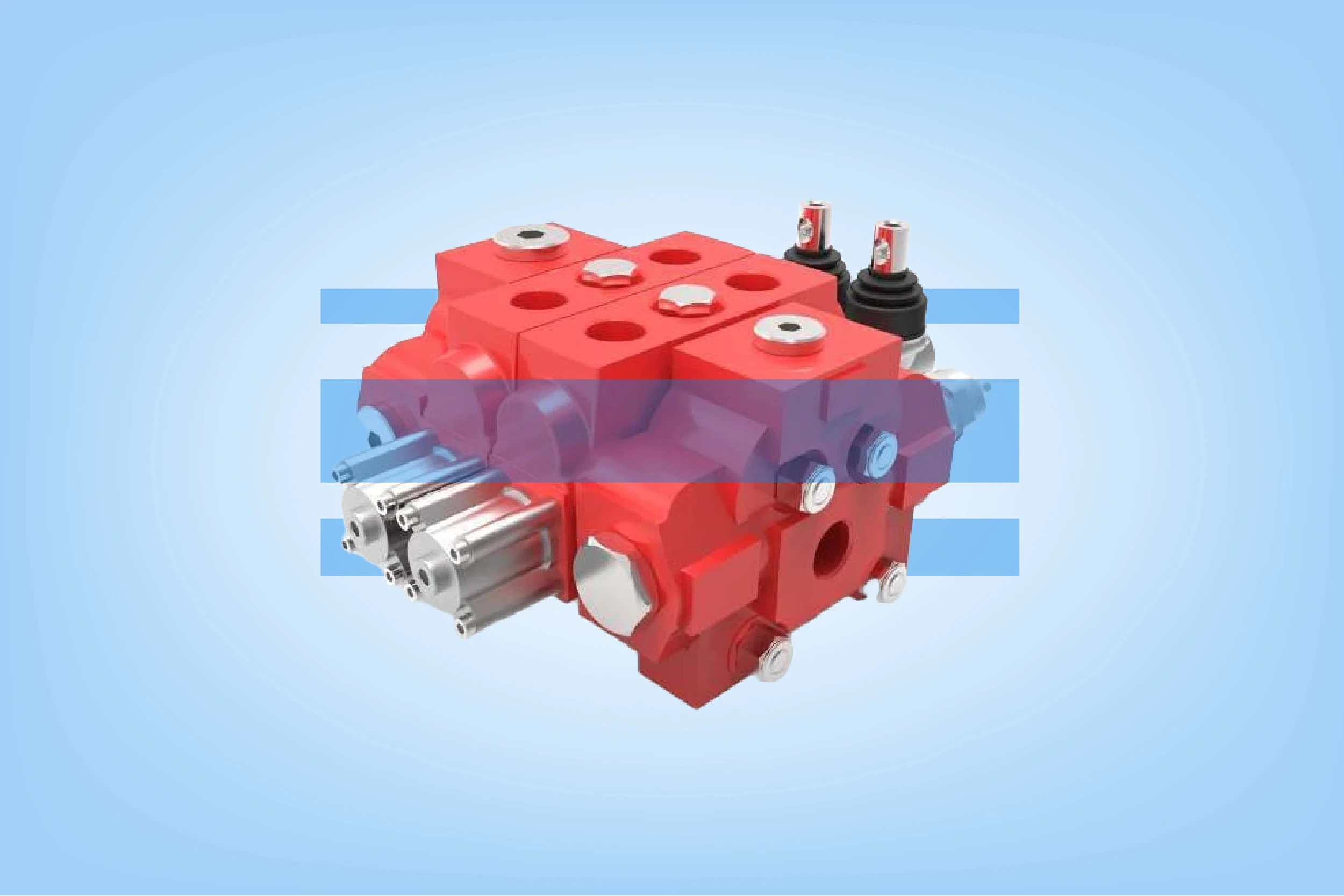
Hydraulic directional control valves play a central role in the operation of a hydraulic system: they manage the flow path of the oil and allow it to be directed toward the different components of the circuit.
Their function is therefore to control the movement of actuators, such as hydraulic cylinders and motors, determining where the fluid must be directed within the system.
Choosing the correct valve depends on the characteristics of the system, the flow rate and operating pressure, the number of functions to be controlled and the type of actuation required.
Understanding the operating principle and the main available configurations helps identify a solution that is suitable for the machine’s requirements.
What is a hydraulic directional control valve?
A hydraulic directional control valve is a component used to control the direction of fluid within a hydraulic circuit.
The pump sets the oil in motion and sends it into the circuit. The directional control valve then manages its flow path toward one or more actuators.
It can be thought of as a flow-routing system: depending on the position of the control mechanism, the fluid is directed along a specific path.
In this way, the valve can, for example, control the extension or retraction of a cylinder or change the direction of rotation of a hydraulic motor.
For this reason, it is one of the fundamental components used to control movement in hydraulic systems.
How does a hydraulic directional control valve work?
Its operation depends on the configuration of the component, but the general principle remains simple.
The valve has several ports through which the fluid enters and exits. The control mechanism changes the internal connections and allows the oil to reach the required section of the circuit at that particular moment.
In spool valves, which are widely used in hydraulic applications, the movement of an internal element opens and closes different flow passages.
Consider a double-acting hydraulic cylinder.
To move the piston in one direction, the valve sends fluid to one side of the cylinder while allowing the oil on the opposite side to return through the return circuit.
When the control changes position, the flow path is reversed and the cylinder moves in the opposite direction.
It is precisely this ability to change the oil flow path that makes the directional control valve essential for controlling the machine.
Ways and positions of a hydraulic directional control valve
Among the most important characteristics of a directional control valve are the number of ways and the number of positions.
These values are often indicated using designations such as:
- 2/2;
- 3/2;
- 4/2;
- 4/3.
The first number generally indicates the number of connections controlled by the valve, while the second indicates the number of positions the component can assume.
A 4/3 valve, for example, has four ways and three positions.
The required configuration varies according to the circuit and the type of actuator that must be controlled.
It is therefore not enough to consider only the number of ways. The operating behaviour of the valve in its different positions must also be checked.
Main types of hydraulic directional control valves
The market offers numerous configurations designed to meet the different requirements of industrial and mobile hydraulic systems.
A first distinction can be made according to the structure of the valve.
Monoblock directional control valves
Monoblock directional control valves integrate multiple elements within a single body.
Their compact construction makes them suitable for many applications in which one or more movements need to be controlled through a relatively simple solution.
The configuration is selected according to the number of functions and the characteristics of the hydraulic system.
Sectional directional control valves
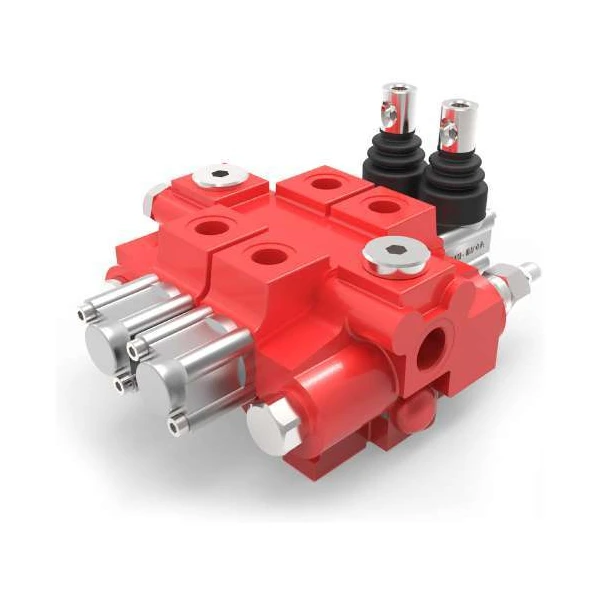
Sectional directional control valves, on the other hand, consist of multiple assembled sections.
This solution allows the system to be configured according to the different functions required by the machine.
Modularity is one of the main advantages when the system requires multiple functions or specific configurations.
LubeTeam Hydraulic offers several solutions in the section dedicated to Hydraulic Directional Control Valves, designed for different applications and system configurations.
Types of actuation for hydraulic directional control valves
Another important factor is the way in which the directional control valve is actuated.
The choice depends on the machine, the required level of automation and the way in which the operator needs to control the system.
Manual actuation
Manual actuation is generally operated through a lever.
It is a simple solution widely used on machines where the operator directly controls the movements of the hydraulic system.
Electrical actuation
Electrical actuation uses an electrical signal to operate the valve.
This configuration makes it possible to integrate the hydraulic system with the machine’s electrical and electronic systems and is therefore widely used in automated equipment.
Hydraulic or pneumatic actuation
In certain applications, the valve can be actuated by a hydraulic or pneumatic signal.
The solution is selected according to the architecture and specific requirements of the circuit.
Proportional control
Proportional directional control valves allow more gradual movement control than traditional systems that operate mainly through defined positions.
This technology is used when the application requires more precise and progressive control of movement.
How to choose a hydraulic directional control valve
The selection of a directional control valve should not be based solely on the size of the ports or the number of available levers.
The entire hydraulic circuit and the actual operating conditions of the component must be taken into consideration.
System flow rate
Flow rate is one of the first parameters to consider.
The valve must be compatible with the amount of oil flowing through the circuit during operation.
Using a component that is not suitable for the characteristics of the system can negatively affect overall performance.
For this reason, the flow rate specified by the manufacturer should always be compared with the actual system data.
Operating pressure
Pressure is also a fundamental parameter.
Each directional control valve is designed to operate within specific operating conditions.
The pressure expected within the circuit must therefore be compatible with the values permitted for the component.
This check should be carried out using the manufacturer’s technical documentation and taking the overall characteristics of the system into account.
Number of functions
It is also necessary to determine how many actuators or functions need to be controlled.
A simple machine may require control of only one cylinder, while more complex systems may include numerous actuators.
The number of functions therefore affects the configuration and the number of sections required.
Type of actuation
Manual, electrical, hydraulic or proportional: the actuation system must also be selected according to the application.
A machine operated directly by an operator may have very different requirements compared with an automated industrial system.
Type of hydraulic system
Finally, the directional control valve must integrate correctly with the other components of the circuit.
Pumps, valves, cylinders, motors and directional control valves all operate as parts of the same system.
For this reason, the selection process must always take the overall operation of the machine into account rather than considering the individual component in isolation.
Why oil quality is important
Hydraulic fluid plays a fundamental role in the operation of the entire system.
The presence of contaminants can compromise the correct operation of components and progressively increase wear.
Directional control valves contain internal elements that must move correctly in order to open and close the various oil passages. The presence of particles or impurities can therefore interfere with their operation.
Proper filtration and regular fluid maintenance help protect the directional control valve and the other components of the circuit.
Using an oil with characteristics suitable for the application is also essential.
The choice of fluid should always follow the specifications provided for the machine and its components.
Signs of a possible directional control valve problem
A hydraulic directional control valve can show different symptoms when something in the system is not working correctly.
Signs that may require inspection include:
- irregular actuator movement;
- difficulty in operation;
- slower response than normal;
- oil leaks;
- unusual noise;
- abnormal increase in circuit temperature.
These symptoms do not necessarily indicate a fault in the directional control valve.
A hydraulic system consists of many interconnected components, and the same problem may originate from the pump, fluid, valves, actuators or other parts of the system.
For this reason, it is important to carry out a complete diagnosis before replacing a component.
Maintenance of hydraulic directional control valves
Proper maintenance helps preserve the reliability of the directional control valve and the entire circuit over time.
The first element to check is the hydraulic fluid.
Keeping the oil within the required condition and monitoring the state of the filtration system helps reduce the presence of contaminants.
It is also useful to periodically check for leaks and inspect connections and actuation systems.
For electrically actuated directional control valves, inspections should also include connectors and electrical components.
When abnormal behaviour is detected, it is advisable to first identify the cause of the problem and then assess the necessary corrective action.
Maintenance based on periodic inspections makes it easier to identify potential anomalies before they can significantly affect machine operation.
Hydraulic directional control valves and system reliability
The directional control valve must operate together with all the other components of the circuit.
Choosing a suitable component therefore means considering flow rate, pressure, number of functions, actuation method and the general characteristics of the machine.
There is no single directional control valve that is universally better than all others.
There is, however, a solution that is better suited to the conditions in which the system must operate.
Correct selection therefore begins with an analysis of the application and verification of the technical data provided by manufacturers.
Relying on components that are compatible with the system and keeping the condition of the hydraulic fluid under control helps preserve the reliability, operating continuity and performance of the hydraulic system over time.