


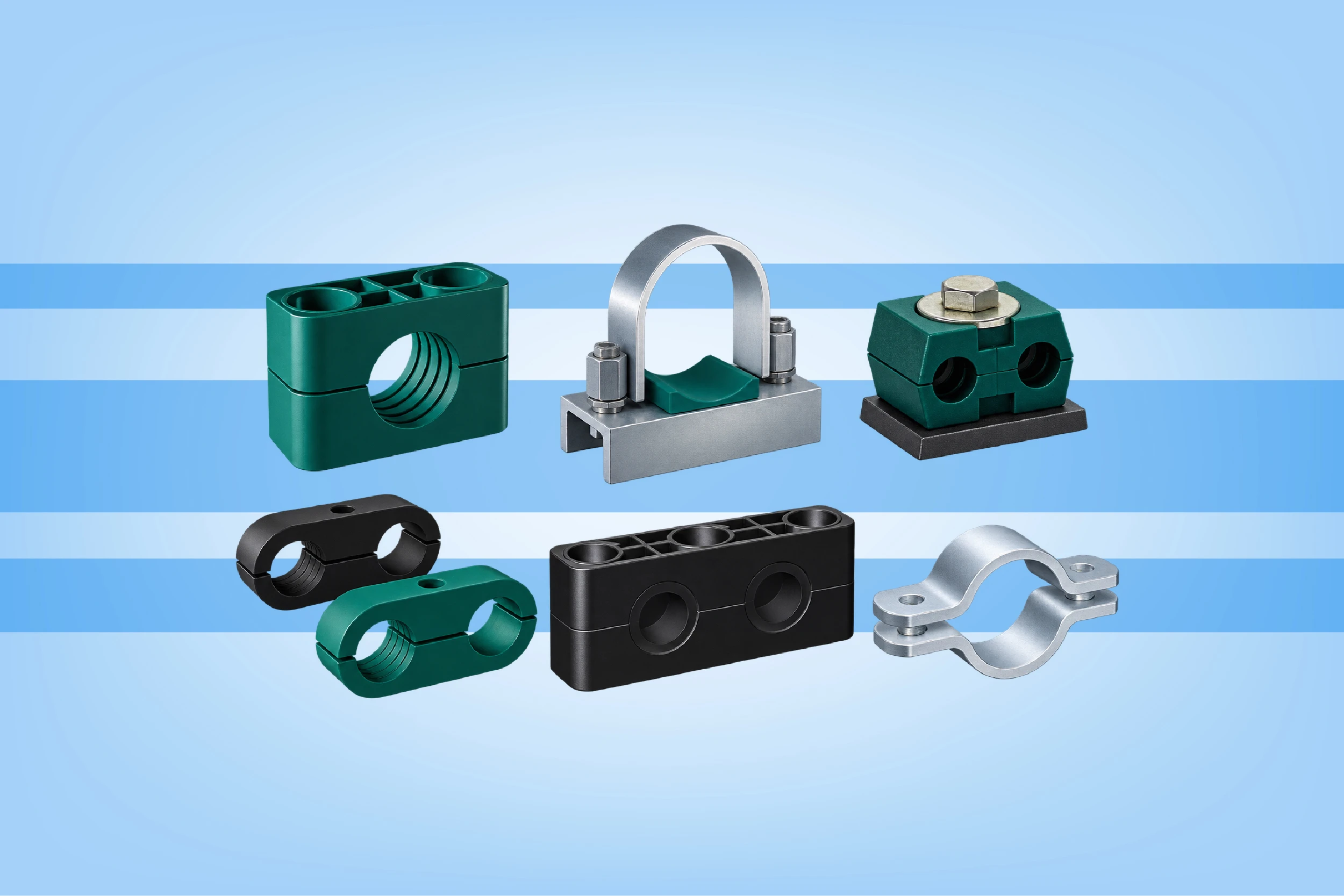
Hydraulic pipe clamps play a fundamental role in the stability and safety of industrial hydraulic systems. These components ensure that pipes are securely fastened, limit unwanted movement, and help protect the circuit from mechanical stresses generated during operation.
In a hydraulic system, pipes do more than simply carry pressurized oil. They must also withstand vibrations, pressure pulsations, temperature fluctuations, and forces that can progressively compromise the integrity of connections.
A suitable fastening system helps control these phenomena, reducing the risk of damage, leaks, and unplanned maintenance.
Selecting the right clamps therefore requires careful consideration of pipe characteristics, operating conditions, and the structural requirements of the system.
What Are Hydraulic Pipe Clamps and What Are They Used For?
Hydraulic pipe clamps are mechanical devices designed to secure and support pipes within a hydraulic circuit. They keep pipes in their intended design positions and control their movement relative to supporting structures.
Typically, a clamp consists of two clamping halves that surround the pipe and a fastening system comprising mounting plates, screws, and other accessories, depending on the configuration.
The component’s geometry distributes clamping forces across the pipe surface, while the material of the clamp body partly determines its response to vibrations, temperature, and mechanical stresses.
Main Functions of Pipe Clamps
Pipe fastening addresses several operational requirements.
First, clamps prevent excessive movement that could compromise connection alignment. They also limit pipe oscillations and help reduce stress on fittings.
A properly designed support system also maintains adequate clearance between pipes, metal structures, and surrounding components, preventing contact and abrasion.
Finally, clamps facilitate circuit organization, making hydraulic lines more accessible during inspection, maintenance, and replacement operations.
The Role of Pipe Clamps in Hydraulic Vibration Control
Vibrations are among the main dynamic stresses affecting pipes in hydraulic systems.
Pumps, hydraulic motors, valves, and other components can generate mechanical oscillations and pressure pulsations that propagate throughout the circuit.
When a pipe lacks adequate support, these stresses can cause repeated movement and concentrate loads at bends, fittings, and connection points.
How Pipe Clamps Help Reduce Vibration and Noise
Pipe clamps limit the amplitude of pipe movement and modify the conditions under which pipes are restrained.
Certain materials and internal profiles also provide damping properties, absorbing part of the vibrational energy and reducing the transmission of oscillations to surrounding structures.
This function is particularly important in systems characterized by frequent operating cycles, rapid pressure fluctuations, or continuous operation.
However, it is essential to distinguish between controlling vibrations and eliminating them: clamps do not replace measures addressing the underlying causes of pressure pulsations, nor can they independently guarantee the absence of resonance.
Proper sizing, combined with appropriate support positioning, helps improve the dynamic behavior of the entire pipeline.
Consequences of Inadequate Pipe Fastening
An undersized, loose, or incorrectly positioned clamp can compromise pipe stability.
Repeated oscillations contribute to material fatigue, while friction against rigid surfaces can damage protective coatings.
Over time, these conditions increase the risk of loose connections, localized deformation, and fluid leaks.
Inspecting fastening systems is therefore an important part of preventive maintenance in hydraulic installations.
Types of Hydraulic Pipe Clamps
The market offers various clamp configurations designed to meet specific load, space, and installation requirements.
Selection primarily depends on pipe diameter, expected mechanical stresses, and the characteristics of the operating environment.
DIN 3015 Pipe Clamps: Features and Applications
Clamps complying with the DIN 3015 standard are widely used for securing industrial piping.
The standard distinguishes three main series:
- DIN 3015-1, standard series: suitable for numerous industrial applications with conventional fastening requirements.
- DIN 3015-2, heavy-duty series: provides greater structural strength for configurations requiring higher load-bearing capacity.
- DIN 3015-3, twin series: allows two parallel pipes to be secured using a single support assembly.
This classification facilitates component selection according to the mechanical and dimensional characteristics of the system.
However, dimensional compliance does not eliminate the need to verify the performance of each individual product, particularly when significant dynamic loads are involved.

Light-Duty and Heavy-Duty Pipe Clamps
Light-duty pipe clamps provide a compact solution for supporting pipes subjected to loads compatible with the component’s performance specifications.
They are used in hydraulic power units, industrial machinery, and systems where designers need to organize pipe runs while minimizing space requirements.
Heavy-duty clamps, on the other hand, feature more robust configurations and are suitable for applications requiring greater support capacity.
Selection does not depend solely on circuit pressure. Pipe weight, diameter, vibrations, routing geometry, and loads acting on the supporting structure must also be considered.
Twin Pipe Clamps and Metal Pipe Clamps
Twin pipe clamps support two parallel pipes through a shared fastening system.
This configuration promotes an orderly arrangement of hydraulic lines and can simplify installation in circuits with limited space.
Metal pipe clamps, meanwhile, meet specific mechanical strength and environmental resistance requirements.
Their selection requires particular attention to contact points with the pipe, as rigid contact can transmit vibrations or promote wear if the design does not include adequate protective measures.
Pipe Clamp Materials: Characteristics and Selection Criteria
Clamp material directly influences mechanical strength, vibration behavior, and compatibility with the operating environment.
There is no universally superior material: each solution has characteristics that designers must evaluate against the actual operating conditions of the system.
Polypropylene Pipe Clamps
Polypropylene offers a good balance of low weight, chemical resistance, and load-bearing capability.
It is widely used in industrial fastening systems thanks to its compatibility with numerous fluids and the possibility of manufacturing compact components.
However, designers must verify the maximum operating temperature and permissible loads, as the material’s mechanical properties change as temperature increases.
Polyamide, Rubber, and Aluminum Pipe Clamps
Polyamide provides rigidity and mechanical strength, making it suitable for numerous industrial applications. Flame-retardant versions also meet specific fire performance requirements.
Thanks to its elasticity, rubber can help dampen vibrations and protect contact surfaces. Its compatibility with oils, temperatures, and chemical agents must be verified.
Aluminum represents an alternative for applications requiring greater rigidity and specific thermal or mechanical properties.
For all these materials, the manufacturer’s technical data sheet is the primary reference for identifying operating limits and conditions of use.
How to Choose Hydraulic Pipe Clamps
Selecting a pipe clamp requires an assessment that simultaneously considers dimensions, loads, and operating conditions.
Outside Diameter and Pipe Characteristics
The outside diameter is the first parameter to verify.
An oversized clamp cannot ensure adequate fastening, while an undersized component may exert excessive pressure on the pipe surface.
It is important to distinguish between the nominal pipe diameter and the actual outside diameter, especially when the system uses pipes with different wall thicknesses.
For flexible hoses, the characteristics of the outer cover and the manufacturer’s instructions must also be considered, avoiding excessive tightening that could deform the hose structure or restrict necessary movement.
Pressure, Temperature, and Mechanical Stresses
Circuit pressure indirectly influences support selection through the forces and pulsations acting on the pipes.
Designers must also assess temperature variations, as thermal expansion can generate additional stresses when fastening points prevent the necessary movement.
An effective system must therefore distinguish between points requiring rigid fastening and those where controlled thermal expansion must be allowed.
Operating Environment and Material Compatibility
Humidity, chemicals, oils, and aggressive environmental conditions can progressively damage fastening components.
In corrosive environments, suitable materials and surface treatments must be evaluated, with attention also given to bolts and mounting plates.
Proper selection must consider the entire fastening assembly, not just the clamp body.
Pipe Clamp Installation: Positioning and Tightening
Even a correctly sized clamp may deliver inadequate performance if installation does not meet the circuit’s requirements.
Spacing Between Clamps and Mounting Points
The spacing between supports depends on pipe diameter, geometry, and operating stresses.
Particularly long straight pipe sections may require intermediate supports to limit deflection and oscillation.
Near bends, fittings, and valves, however, additional fastening points may be necessary.
Manufacturers’ technical recommendations, including those relating to DIN 3015 clamps, provide reference values that designers must adapt to actual application conditions.
Proper Tightening and Prevention of Deformation
Tightening must ensure stability without damaging the pipe or clamp body.
Insufficient tightening torque can allow unwanted movement, while excessive torque can deform components and alter force distribution.
Installers must use the tightening torque values specified by the manufacturer and verify that mounting plates, screws, and contact surfaces provide stable anchoring.
After installation, visual and functional inspections help identify interference, misalignment, or abnormal contact points.
Preventive Maintenance of Hydraulic Pipe Clamps
Regular inspection of pipe clamps helps preserve the reliability of the piping system.
During inspections, maintenance personnel should check for looseness, deformation, corrosion, and material deterioration.
Particular attention should be paid to points subjected to frequent vibrations, temperature variations, and cyclic stresses.
The appearance of abrasion marks, unusual noises, or excessive movement may indicate a problem with the support system.
Before carrying out any intervention, personnel must shut down and secure the system, release residual pressure according to established procedures, and verify the absence of hazardous conditions.
Prompt replacement of a damaged clamp helps prevent more serious consequences for pipes and connections.
LubeTeam Hydraulic Pipe Clamps: Industrial Fastening Solutions
LubeTeam Hydraulic offers a range of Pipe Clamps designed to meet the different fastening requirements of hydraulic and pneumatic circuits.
The product range includes DIN 3015 pipe clamps, metal clamps, light-duty, heavy-duty, and twin configurations, as well as additional support systems.
Available solutions include components made from polypropylene, flame-retardant polyamide, rubber, and aluminum, with configurations suitable for different installation conditions.
For DIN 3015 clamps, LubeTeam offers products from STAUFF and AEGI, available as complete kits or individual components, for pipes with outside diameters ranging from 6 to 102 mm, depending on the specific product range.
Technical support in component selection helps identify solutions aligned with the dimensional and operational characteristics of the system.
Careful design and proper installation of the fastening system help protect pipes, reduce stress on connections, and maintain reliable operating conditions over time.
Choosing the right hydraulic pipe clamps means investing in circuit stability, operational safety, and uninterrupted industrial production.