


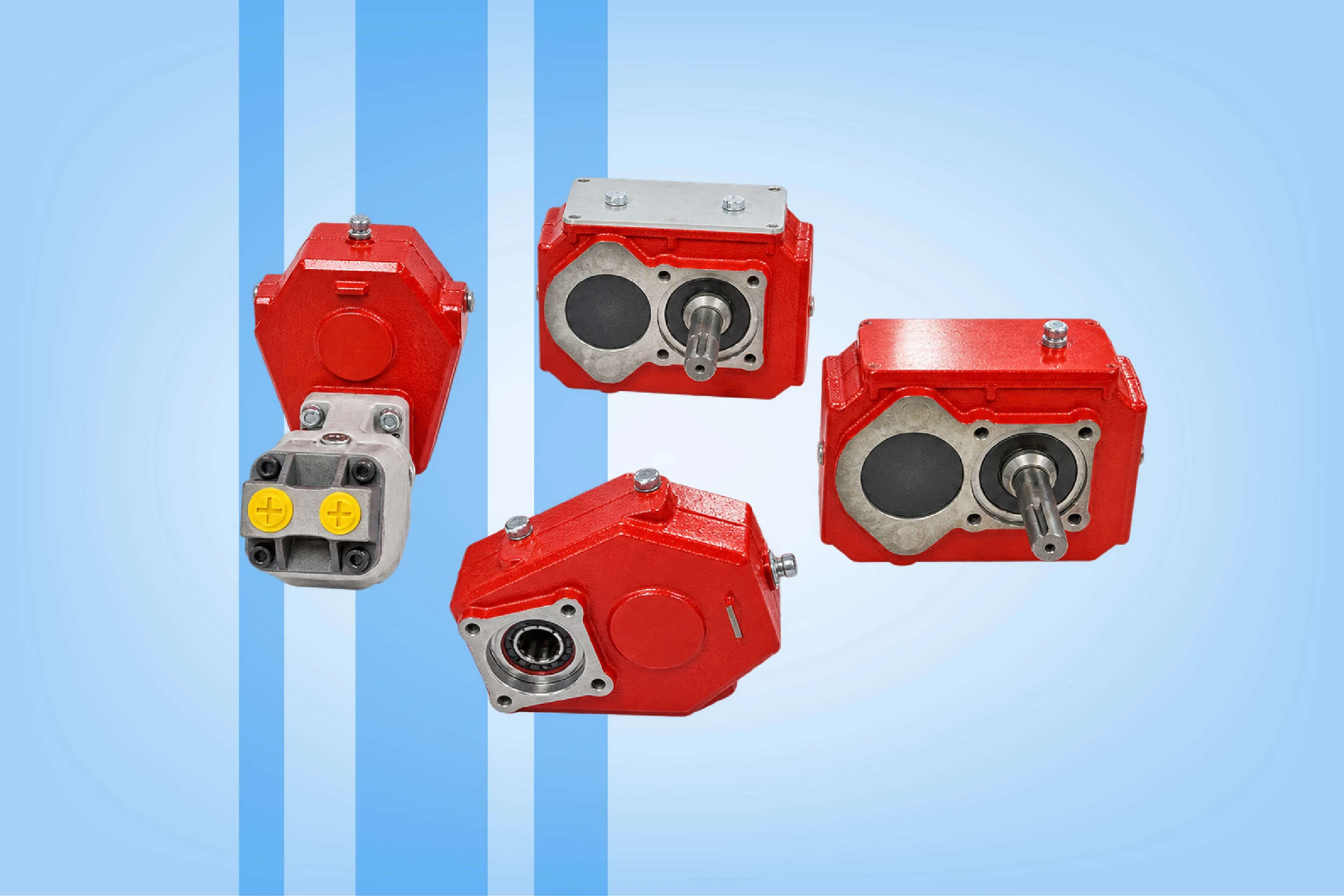
The rotational speed of a hydraulic pump directly affects the oil flow rate supplied to a hydraulic circuit. When a machine is equipped with a power take-off operating at a lower rotational speed than the pump requires, the system needs a component capable of adapting the mechanical power transmission.
A speed increaser for hydraulic pumps performs this function: it receives rotational motion from a drive shaft or power take-off and transmits it to the pump while increasing the rotational speed.
This component is mainly used in mobile hydraulic systems, agricultural machinery, and equipment that relies on a mechanical power source to drive a hydraulic circuit.
However, achieving reliable performance involves more than simply increasing rotational speed. The pump specifications, available power, gear ratio, and operating conditions of the entire system must also be considered.
What Is a Speed Increaser and How Does It Work?
A speed increaser, also known as a gearbox speed increaser, is a mechanical transmission component that increases the rotational speed between an input shaft and an output shaft.
Its operation is generally based on a gear system enclosed within a housing. The gears transfer motion from the drive shaft to the shaft connected to the pump, changing the ratio between their respective rotational speeds.
Unlike a speed reducer, which decreases the output rotational speed, a speed increaser makes it possible to achieve a higher rotational speed than that supplied by the mechanical power source.
Speed Increase Ratio
The speed increase ratio indicates how much the rotational speed increases between the input and output shafts.
Consider a power take-off rotating at 540 revolutions per minute. Using a speed increaser with a 1:3 ratio, the output shaft theoretically reaches 1,620 revolutions per minute.
This configuration can be useful when the pump requires a higher rotational speed than that directly available from the power take-off.
However, the ratio must comply with the pump’s operating limits. Excessive rotational speed can compromise oil suction, increase mechanical stress, and accelerate component wear.
Speed, Torque, and Power: What Actually Changes?
A speed increaser does not generate additional power. It changes the relationship between speed and torque while transmitting the available mechanical energy.
As rotational speed increases, the torque available at the output shaft decreases. Furthermore, friction within the gears and bearings inevitably causes energy losses.
This aspect is particularly important in hydraulic applications because the pump requires a specific amount of torque to operate at the pressure demanded by the circuit.
Therefore, a higher speed increase ratio does not automatically represent a better solution. Proper sizing must ensure a balance between the rotational speed, torque, and power actually available.
From the Power Take-Off to the Hydraulic Pump: How Is Power Transmitted?
The power take-off, commonly referred to as PTO (Power Take-Off), allows part of an engine’s mechanical power to be transferred to external equipment.
In agricultural tractors, for example, the power take-off can drive numerous devices through a mechanical connection.
When the equipment uses an independent hydraulic circuit, this rotational motion can drive a hydraulic pump that delivers the flow rate required to operate the actuators.
A speed increaser is used when the rotational speed of the power take-off does not match the speed required by the pump.
The Mechanical Power Transmission Process
The system operates according to a specific sequence.
The machine’s engine supplies mechanical power to the power take-off. The PTO then transfers rotational motion to the speed increaser’s input shaft, which increases rotational speed through its internal gear system.
The output shaft subsequently drives the hydraulic pump. The pump draws oil from the reservoir and delivers it into the circuit, generating a flow rate that enables the actuators to perform the required movement. The resistance of the load determines the pressure needed.
In this configuration, the speed increaser acts as the functional connection between the mechanical power source and the pump.
When Is a Speed Increaser Actually Needed?
Not every application requires a speed increaser.
If the power take-off already provides a rotational speed compatible with the pump and the hydraulic circuit achieves the required performance, a direct connection may be an appropriate solution.
A speed increaser becomes useful when rotational speed needs to be increased to achieve a higher flow rate, without exceeding the operating limits of the pump or transmission.
The choice therefore depends on the specific application requirements rather than simply on the presence of a power take-off.
What Are the Advantages of a Speed Increaser in Hydraulic Systems?
Using a properly sized speed increaser makes it possible to drive a pump requiring a higher rotational speed from a low-speed mechanical power source.
The main advantage is the ability to achieve the necessary flow rate without necessarily modifying the power source.
Adjusting the Hydraulic Flow Rate
In fixed-displacement pumps, the theoretical flow rate increases proportionally with rotational speed.
A pump operating at a low speed transfers less oil per unit of time than the same pump operating at a higher speed.
A speed increaser allows the pump to reach the required rotational speed, supporting the proper operation of hydraulic cylinders and motors.
However, the increase in speed must remain compatible with the available power and the pump’s suction conditions.
Flexibility in Mobile Applications
Agricultural machinery and industrial vehicles often use power take-offs with standardized rotational speeds.
A speed increaser allows these mechanical power sources to be adapted to the requirements of different pumps, offering greater flexibility when configuring equipment.
This solution can simplify the integration of an independent hydraulic circuit, provided that the design takes into account space requirements, mechanical connections, and transmission specifications.
How to Choose a Speed Increaser for a Hydraulic Pump
Selecting the right speed increaser requires a combined assessment of the mechanical power source, the speed increaser, and the pump.
Each component must operate within the limits specified by its manufacturer. Incorrect sizing can compromise performance even when the mechanical connections appear compatible.
Gear Ratio and Pump Speed
The first parameter to consider is the relationship between the available input speed and the rotational speed required by the pump.
It is necessary to determine the actual speed of the power take-off and compare it with the pump’s permitted operating range.
The speed increaser must enable the pump to achieve the required flow rate without exceeding its maximum allowable speed, while also accounting for possible speed variations during operation.
Available Power and Transmissible Torque
Rotational speed is not the only selection criterion.
The operating pressure and displacement of the pump determine the torque required to drive it. Consequently, the speed increaser must withstand the expected mechanical stresses and transmit sufficient power.
Peak loads, start-up conditions, and operating cycle duration must also be evaluated.
A component sized exclusively for nominal operating conditions may not withstand more demanding loads.
Compatibility of Mounting Connections and Shafts
The connection between the speed increaser and the pump requires verification of dimensions and mechanical specifications.
Flanges, shafts, splines, and fastening systems must ensure proper mechanical coupling.
The different configurations available make it possible to connect pumps belonging to different size groups. However, the selection must always comply with the technical specifications of each component.
LubeTeam Hydraulic offers a range of Speed Increasers, including Borelli solutions for different pump groups, through-shaft configurations, and cast-iron versions.

Applications of Speed Increasers
Speed increasers are used in applications where a mechanical power source must drive a hydraulic pump at a higher rotational speed.
Agricultural Machinery
In the agricultural sector, many types of equipment use the tractor’s power take-off to operate mechanical and hydraulic systems.
When a pump requires a higher rotational speed than the one available, a speed increaser allows the speed to be adjusted accordingly.
This configuration can be useful in equipment equipped with independent hydraulic circuits, provided that the system has sufficient available power.
Industrial Vehicles and Construction Equipment
Truck-mounted hydraulic equipment and certain types of construction machinery may also use speed increasers to connect a mechanical power source to a pump.
In these applications, sizing must take into account load variations, frequency of use, and environmental conditions.
A properly selected component contributes to consistent power transmission and uninterrupted equipment operation.
Common Problems and Maintenance of Speed Increasers
Like any mechanical transmission component, a speed increaser requires proper operating conditions and periodic inspections.
Unusual noise, vibrations, overheating, and lubricant leaks may indicate mechanical problems or unsuitable operating conditions.
Overheating and Lubrication
During operation, gears and bearings generate heat due to friction.
Lubricants reduce direct contact between metal surfaces and help minimize wear.
Insufficient lubrication, unsuitable viscosity, or excessive loads can increase the operating temperature of the assembly.
Lubricant level, condition, and specifications must be checked according to the manufacturer’s recommendations.
Vibrations, Noise, and Wear
Increased noise levels may be caused by damaged gears, worn bearings, loose fasteners, or incorrect mechanical couplings.
Vibrations are also an important warning sign, particularly when they occur after maintenance work or pump replacement.
If abnormalities are detected, the mechanical connections, support conditions, and possible excessive play should be inspected.
Prompt intervention helps reduce the risk of damage to other transmission components.
Periodic Inspections and Failure Prevention
Effective maintenance includes checking for leaks, monitoring operating temperatures, inspecting fasteners, and assessing lubricant condition.
During scheduled maintenance, the condition of shafts and mechanical couplings should also be verified.
Operating conditions determine inspection frequency. Applications involving heavy loads, prolonged operating cycles, or particularly demanding environments may require more frequent checks.
Speed Increasers and Hydraulic Pumps: The Importance of Proper Sizing
A speed increaser is an important component in mechanical transmission systems designed to drive hydraulic pumps.
Its function is to adapt the available rotational speed to the pump’s requirements while maintaining the correct balance between speed, torque, and power.
Selecting the right component therefore requires an analysis of the entire system, including the power take-off, gear ratio, pump, mechanical connections, and operating conditions.
LubeTeam Hydraulic offers a range of speed increasers and mechanical transmission components for different hydraulic applications, combining component distribution with technical support to help customers select the most suitable solutions for their system requirements.