 Grices CC Series Hydraulic Cylinders


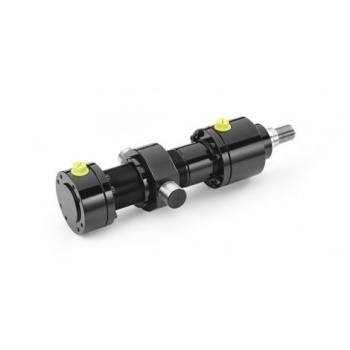
Grices CC Series Hydraulic Cylinders have been specifically engineered and developed to comply with the strict international ISO 6022 standard. Their round end-cap construction makes them particularly suitable for the most demanding actuation requirements typical of the steelmaking and heavy industrial sectors. Their high quality standard is ensured by the rigorous selection of materials, advanced manufacturing processes and strict hydraulic and electronic testing performed on 100% of the cylinders before they are placed on the market.
The cylinder barrel is manufactured using premium-quality steel tubing, which may be cold-drawn or hot-rolled depending on the specifications. This component features a high structural wall thickness and an internal microfinish with a maximum roughness of 0.4 microns and H8 diameter tolerance. The piston rods are made of high-grade steel and hard chrome-plated. This specific surface treatment provides significant resistance to damage and considerably extends the service life of the seals. The piston rod surface finish is guaranteed at a minimum of 0.2 microns. The end caps, also made of steel, are machined to ensure perfect concentricity between the piston rod, bushing and barrel; they also feature large internal passages designed to minimise fluid pressure losses. The piston, made of a special material, ensures excellent stability during movement and reduces piston rod deflection caused by any external radial loads.
These hydraulic actuators operate at a continuous nominal pressure of 25 MPa (250 bar) and can safely withstand a maximum test pressure of 32 MPa (320 bar). They are available in a wide range of sizes, with bore diameters from 50 to 320 mm and operating strokes of up to 4000 mm. Hardware configurations include single-rod or double-rod versions, with five different basic mounting types according to ISO standards: MF3, MF4, MT4, MP5 and EB.
For operating speeds above 0.1 m/s or for the safe actuation of vertical loads, fully adjustable progressive front and rear end-of-stroke cushioning systems are available. These cushioning systems use self-centring plungers to gradually decelerate even substantial masses, while also acting as a crucial safety element in the event of control servo system failure. Adjustment is carried out through needle valves equipped with a locking system that prevents accidental removal.
The internal seal grooves strictly comply with ISO 7425. The cylinders can be configured with different compounds according to the operating environment: standard Type B seals, made of low-friction Nitrile and PTFE, for speeds of up to 4 m/s and temperatures from -10 to +75 degrees Celsius; Type C seals, made of Viton and PTFE, for high-temperature fluids up to 135 degrees Celsius; and Type H seals, with a Chevron profile, specifically recommended when loads must be held in position for extended periods.
For precise position detection, CC Series cylinders can integrate proximity sensors screwed directly into the end caps. These industrial sensors operate between -25 and +80 degrees Celsius, withstand dynamic pressures of up to 350 bar and provide a PNP logic output signal. The many other options include air bleed valves at both ends, dedicated drain circuits for high-speed applications or strokes exceeding 2000 mm, SAE 6000 psi flanges and complete preparation for absolute magnetostrictive position transducers. Finally, for cylinders with strokes exceeding 1000 mm, the technical department recommends the use of dedicated internal spacers to increase piston rod guidance capacity and drastically limit overloading and wear.
| Feature | Value |
|---|---|
| Reference Standard | ISO 6022 |
| Nominal Pressure (Continuous Operation) | 25 MPa (250 bar) |
| Maximum Pressure | 32 MPa (320 bar) |
| Bore Size | From 50 to 320 mm |
| Maximum Stroke | Up to 4000 mm |
| Piston Rod Options | Single or double rod (chrome-plated, hardened/chrome-plated, nickel/chrome-plated, stainless steel) |
| Basic Mounting Types (ISO Standard) | EB, MF3, MF4, MT4, MP5 |
| End-of-Stroke Cushioning | Front and rear, adjustable (optional) |
| Supported Sensors | Integrated proximity sensors (PNP) / Magnetostrictive transducers |
| Standard Seals (Type B) | Nitrile + PTFE (-10 / +75 degrees Celsius) |
| Oil Ports | BSP threaded, DIN 3852/2 (Option: SAE 6000 psi flanges) |
| Model (Bore / Piston Rod) | Bore Size (mm) | Piston Rod Diameter (mm) | Piston Rod Thread (KK) |
|---|---|---|---|
| 50 / 36 | 50 | 36 | M27x2 |
| 63 / 45 | 63 | 45 | M33x2 |
| 80 / 56 | 80 | 56 | M42x2 |
| 100 / 70 | 100 | 70 | M48x2 |
| 125 / 90 | 125 | 90 | M64x3 |
| 160 / 110 | 160 | 110 | M80x3 |
| 200 / 140 | 200 | 140 | M100x3 |
| 250 / 180 | 250 | 180 | M125x4 |
| 320 / 220 | 320 | 220 | M160x4 |